Deprecated: Methods with the same name as their class will not be constructors in a future version of PHP; Calendar has a deprecated constructor in /data03/c6906214/public_html/wp-content/plugins/lumia-calender/lumia-calendar.class.php on line 5
Writer-insighter – Page 34 – Maybe it doesn't matter if it's true. So long as you believe it is.

So this is Christmas

This! This is how Christmas should be! Like this! Or it's just rubbish and it's all your fault!
This is how Christmas should be. Like this. Or it’s just rubbish and it’s all your fault. Especially if you can’t be bothered to look like this first thing on Christmas morning. Oh it just doesn’t matter, does it? No. Don’t you worry about it. It’s probably too much trouble, isn’t it? Nothing. I said nothing, alright? Jeez…

I didn’tused to like Christmas. Mostly because it was nothing like the Christmases I liked, to paraphrase the old song. It wasn’t just because Christmases were hardly ever white; where I grew up in Wiltshire they were mostly damp and muddy along with cold, a time of runny

I mean maybe it's me, but I just can't see how it's very, you know, Christmassy, somehow...
I mean maybe it’s me, but I just can’t see how it’s very, you know, Christmassy, somehow…

noses and sore nostrils in way that doesn’t happen with colds now. I haven’t given much thought to why, except not using cotton hankies might have quite a lot to do with it. Christmas always got like this quite quickly. Boxing Day was moderately worse. It wasn’t just that everything was shut but we’d have to go and follow a hunt somewhere. Which was rubbish because we didn’t even ride, let alone hunt. I never knew why we were there at all.

When I say we didn’t ride, we did. A bit. Once a week I had to go to Jenny Dyke’s riding school at Brokerswood. Look, I didn’t give her that name, ok? And I’m sure she was a perfectly nice, well-balanced girl with an active and mixed social life. Albeit one with quite a lot of horses in it.

Riding aside, there were lots of odd things like that about my childhood. We were flat broke. Seriously broke. When one of our succession of rubbish cars broke down once we got £1 for it. So I’m still not sure how come when twice before I left home I needed a suit I was sent to a tailor and a suit was made for me. Seriously. I still don’t understand that, really.

But Christmas was weird. Two films were always on, neither of them anything to do with Christmas. The Great Escape and The Blue Max. Every Christmas. One was about Steve McQueen jumping a motorbike over a hill to not escape from Germany in the Second World War (except it obviously wasn’t and the acting was rubbish). The other was about German pilots stitching each other up in and after the First World War. A sort of NotVery Great Waldo Pepper mit Schnitzel. With that bloke who was in the A Team. Peppard. An easy mistake to make.

It was the one on the right, apparently.

There were presents, obviously. The one I remember best was the Suzi Quatro album. I was told it was just a phase I was going through, although it doesn’t show much sign of wearing off.

The back cover was the same picture but faded. For a while there that Christmas dawn I thought my eyesight had suffered.

I did a milk round one Christmas eve, getting up improbably early. That was really good. A brilliantly sunny morning even if it was cold. I can remember the bang of the gearbox on the electric motor as the milk float started off. That and the smell of milk from the bottles people didn’t wash. That was how we judged what people were like, on the milk float. Did they wash their bottles? It wasn’t a social class proxy, even if we’d known what one of those was. It was much more fundamental. It showed whether or not people gave a damn about anybody else.

One summer I saw Holiday Inn. And no, White Christmas was the name of the song, not the film. I loved everything about it. But more so, It’s A Wonderful Life. The older I get the more truthful that film becomes. It could just be the sherry, obviously, but the mix of the very dark side of Jimmy Stewart (oh, you didn’t know he flew in a bombing raid in Vietnam then?) and his character, combined with the moral of the tale, that you have to try to be a good person and if you try to do that then you’ve done a good thing in itself works for me. Something in me reacted to the sheer nightmarish terror when Jimmy Stewart got his wish, that he’d never been born, trapped seeing the world that would have been, unable to do anything to make it better because that was what he’d asked for, the total abnegation of self. Or as I said, it could have been the sherry.

Shut up. You'll spoil it.
Shut up. You’ll spoil it.

So here’s my ideal Christmas. And I don’t want to hear any happy holidays or crimble or festive season or any other crap. It’s Christmas. December 25th. If you want to talk about other festivals, please do. I hope they’re great. I’m talking about Christmas. Christmas eve and good company and a fire. Midnight mass.

Carols. Proper carols, all about death and cold and the dark and just the smallest glimmer of hope. Ok, you can get all that at home but there’s something about going to church at Christmas.There just is, ok? It’s only once a year.

Preferably somewhere like Blythburgh, some fantastic medieval place either in the middle of nowhere or Norwich Cathedral, in the middle of everything. Either way, a decent choir and a fabulous building. And a driver. Except when I was 18 I used to like driving those midnight black roads, not drinking, just the engine running and no-one around. This is a fantasy Christmas, after all, so both of those things can happen at the same time.

Preferably somewhere like Blythburgh, some fantastic medieval place either in the middle of nowhere or Norwich Cathedral, in the middle of everything. Either way, a decent choir and a fabulous building. And a driver. Except when I was 18 I used to like driving those midnight black roads, not drinking, just the engine running and no-one around. This is a fantasy Christmas, after all, so both of those things can happen at the same time.

Given that, it’s easy to arrange that at midnight I go to check to see if the animals talk, the way that in my family we say they do, remembering a stable. And of course they do. What kind of stupid question is that? Nobody ever said they have to talk with a human voice. Then bed. Then waking up with a stocking filled with presents.

Look, it doesn’t have to be a big stocking, but it has to be one. Or a big sock. And it has to have a satsuma, which I don’t really like, a sugar mouse and a walnut, apart from anything else. Because it does or it’s not Christmas and you’re RUINING IT.

Breakfast, ideally coffee, good bread, gravadlax and of course, as it’s Christmas, chocolate. On the plate, thank-you. Proper chocolate, that’s never been anywhere near a Cadbury’s factory, because they don’t make chocolate, they make chocolate-type confectionary. Even those Belgian sea-shell things from Lidl are better than Cadbury’s. At least they’re chocolate. Maybe, if it’s fine, a walk. Maybe Southwold beach. Could be Aldeburgh. White Lion afterwards if it is. Snape Golden Key if I’m allowed on the way back.

Lunch. The best one ever was a huge cold seafood table my girlfriend of the time did a couple of years back. Apart from the strain of keeping the cat off it, that was the best eat-what-you like-when-you-like Christmas dinners I can remember. It wasn’t quite in the same quantities as Stenna Line used to do on the Newcastle-Kristiansand run, but it was close. And better company.

And a point-to-point meeting on Boxing Day, in a new coat, with rooks calling somewhere and frost on the grass. And friends in the pub afterwards. Friends above all. That’s really what Christmas is about, as we huddle round the fire, just past the shortest day, pretending that even now you can tell the days are getting longer, and in just a few weeks you don’t have to pretend that any more, as we welcome back the Spring.

It’ll happen one day. All of it. I’ll just keep watching stuff like Love Actually until it does.



Share Button

Shooting Times

UKIP’s leader Nigel Farage has apparently called for the de-criminalisation of handguns, to allow people to apply for a licence and own them legally. The way they did in the UK until 1996, when the government banned them after the Dunblane massacre. To be fair, they got close to it before, after the Hungerford shootings in 1988. It’s not as if it’s a Party political thing in the UK. Apart from at UKIP, where Farage has called the handgun ban ‘ludicrous.’

I have to declare an interest. I’m against people making up facts. I’m against gibberish. And I used to shoot. Legally. According to Keith Vaz, that means I encouraged the criminal use of firearms.

This is my true confession. I warn you, it’s pretty….dull.

From the age of 14 I went every Thursday night to the local Territorial Army centre, a big stone barrack block in the middle of Bythesea Road. Which was odd, as it’s an hour’s drive to the sea from there. There was a six-wheeled armoured personal carrier in a shed around the back of the building, which you could see through a gap in the wooden door that people might think an odd thing in a county town now, but we didn’t at the time, close to the Army training ranges on Salisbury Plain and the School of Infantry at Warminster, eight miles away.

A man called Lord Roberts probably had a lot to do with me shooting. Back at the time of the Boer War the British Army got severely mauled by rebel farmers in South Africa, who armed with German Mauser rifles had grand sport shooting British soldiers the same way they’d been shooting game on the veldt – accurately, quickly, from a long way off.


Lord Roberts had these drill halls built all over England. Judging by the smell of the kapok matts we still had most of the original equipment.

I used a BSA Martini-action rifle that belonged to the club, paid my subs and bought the single box of .22 bullets that lasted the evening, not to be taken off the premises, and put on my shooting jacket with the padded elbows and shoulders, adjusted the sling on the fore-end of the rifle so it ran tight, cinched around my left wrist and back around my left bicep to steady the weapon, then went onto the range when we were told it was clear, showed clear, opening the breech to prove there was nothing at all in the firing chamber, laid the weapon down and on the command Walk Forward we all trooped up the range to fix our targets to the wooden frames in front of the six feet of sand and railway sleepers that acted as the backstop.

When we’d done that we walked back to the firing point together and when we were told we could by the Range Officer, only then loaded a bullet into the single-shot rifles, closed the bolt and settled down to get our breathing right.

BSA Martini MkV.  Not exactly looking like a concealable terror weapon, is it?
BSA Martini MkV. Not exactly looking like a concealable terror weapon, is it?

Prone, you aim a rifle with your body, not your arms. Close your eyes, take a breath and when you breath out open them. See where the sights are. If they’re say, left and low then you move your feet to the left and back a little. Close your eyes, breath, open them and see where the sights are now. If you try to hold the gun on target with your hands you’ll almost certainly miss, because once you’ve pulled the trigger you’ll relax. The rifle will drift off to where your body pointed it in the fraction of a second between the cartridge firing and the bullet leaving the end of the barrel. And you’ll miss. With a target pistol it’s a lot more difficult, because you only use one hand and you’ve nothing to brace it on without a sling. Britain won the Olympic shooting event in 1960 in Tokyo. After 1996 the British Olympic team was unable to practice in the UK.

It doesn’t sound very irresponsible or criminal so far, does it? I’d say that if anything, it taught teenage boys self-control, because if they didn’t exercise any they missed the target and no amount of bravado can argue anything different. You missed. The end. If someone was shooting back at you, you’d be dead.

As a club we were ok, I suppose. It was a bit boring sometimes. The old blokes who knew a lot were mostly deaf, because they’d spent a lifetime shooting without the ear defenders we all wore. After about six months it wasn’t that great on the range, not because the mats had never been cleaned in the 70 years they’d been there but because in a pre-air-conditioning age the stench of fired nitro-cellulose and lead shavings in the air got a bit much, especially in summer before the butts were emptied and the sand taken away to be melted down to recover the scrap lead.

After that I went to Bisley and qualified as an adult Marksman at fifteen, then I took up pistol shooting at 20 and taught shooting on summer camp when I was 24. In 1996 the government decided everybody who shot legally should have their guns taken away from them and offered me £170 for a Colt 19911A1 I had spent over £400 customising to suit me. I wrote to the Home Office asking why. They wrote and said something had to be seen to be done.

What puzzles me is why the debate, such as it is, is even more infantile than usual in the UK.

Keith Vaz, the chair of the home affairs committee, said Britain has the toughest gun laws in the world and strong action had been needed following the “horrific tragedy” at Dunblaine.

He added: “The logical consequence of relaxing gun laws, as suggested by Mr Farage, is an increase in gun use which should be discouraged rather than encouraged. Any change could possibly act as a green light for an increase in criminality.

Which should be discouraged. Let’s leave this aside, notwithstanding that this opinion is being presented as a fact. The ‘fact’ that follows is nonsensical.

According to Keith Vaz, changing the law, making something legal which is not currently legal, could increase illegal acts. Exactly how isn’t clear. What is, is that Mr Vaz is reading off the same page of gibberish as Peter Squires, professor of criminology at Brighton University and a member of Association of Police Officer’s advisory group on the criminal use of fire arms, who said legalising handguns “…will generate a demand, it will generate illegal traffic around that demand – the problem with hand guns is that they are small and concealable and they are already the weapon of choice of gangs members and criminals.”

So just to be clear, making something legal will generate a demand for something that is illegal. This is the same logic that says that buying a car legally makes people want stolen cars, except car owners don’t have the police coming round to their house checking that their car is kept in a locked steel box bolted to the wall when it isn’t in use, nor demand that the petrol isn’t kept in it or in the same place except when you’re driving it. But who cares? Car killings are an acceptable part of life. They outnumber firearms deaths by a factor of N. There is never any serious call to ban cars for any reason at all.

But the logic still escapes me. The ACPO advisor says handguns are already the weapon of choice for gangs and criminals. Not would be. Are. And again ‘it will generate” is opinion presented as fact.

I’m not that happy I agree with something Nigel Farage says. About anything. But I don’t accept I contributed to gun culture, whatever that’s supposed to be outside the ravings of the Daily Mail. I don’t accept that I encouraged criminality when I cycled back from Bythesea Road and worried myself sick one week when I discovered a single .22 round left in the pocket of my shooting jacket. That was illegal. The rest of it wasn’t. And we didn’t talk rubbish about it.


Share Button

Making It Up

According to the Guardian today a man driving a black BMW ran down and killed two cyclists. He had to be cut out his car. One of the dead men was Kris Jarvis. According to the Guardian again, a friend of his said this:

“Kris always said he’d die on his bike, such was his love for cycling! None of his loving family or friends could ever imagine that this would be the way he would’ve expected it to happen. Such was his love for cycling.”

Really? Did he? Did he seriously really?

I can’t imagine anyone at all, ever, saying ‘such was his love for cycling.’ It’s the kind of phrase you only ever see written down and even then in one of those sports books with lots of pictures, remaindered from £25 to £1.99 in a shop piled high with travel games and maps of Basingstoke, next to a kebab shop in a rainy suburb somewhere off the north end of the A3.

Even Martin Amis must have blushed when he wrote much the same stuff as a parody about darts in London Fields. But the stupid doesn’t stop there.

He always said he’d die on his bike. No-one could have thought he’d expect it to happen. Well, yes actually. That’s exactly what he did. If the family friend meant ‘he can’t have expected to be killed by a selfish maniac in a car,’ then the family friend can’t have cycled much in the UK.

pedersen

We have a culture here which is based on selfishness. It would be easy to just say ‘Thatcher’ in the manner of a 1980s alternative comedian and leave it at that, but I don’t know if the attitude pre-dated her. Films such as I’m Alright Jack suggest it did and that she simply tapped into a particularly British vein of homicidal conceit.

But evil dead politicians aside, anyone who cycles regularly in Britain knows perfectly well that there are car drivers who feel for their own reasons that Thatcher’s Great Car Economy would be better off with no bicycles around at all, and certainly none in front of their great car.  It’s the reason it’s safer to cycle in the middle of the lane rather than at the side. They might still try to ride you down or crowd you deliberately into the side of the road for daring to be in their sacred way, but they aren’t going to be able to pretend they didn’t see you, or it was an accident, or they didn’t quite realise how close they were when they rode you into the verge.

Sometimes it’s still going to happen. Nobody who cycles thinks it can’t.


Share Button

Ed Milliband’s Secret Diary, aged 13 3/4

Edel Faraband
Edel Faraband

I can’t stand Ed Milliband. This email he sent me – no, seriously, he really did, it’s in the first person after all, so it must have been him, he wouldn’t lie or anything – tells you exactly why.

People sometimes say that they don’t know what we — what I — stand for, so I’ll put this in the simplest terms I can, Carl Bennett. This country is too unequal, and we need to change it.

So here are the promises I’m making to you about the kind of Britain I will lead:

First, I will undo the damage the Tories have done to our country:

  • I will scrap the Bedroom Tax, which unfairly punishes the disabled and the vulnerable.
  • I will scrap the Health and Social Care Act, which damages and undermines our NHS
  • I will scrap the gagging law, which limits our freedom of speech and right to campaign
  • I will reverse the Tories’ £3bn tax cut for millionaires, so we get the deficit down but do it fairly

Some good points there Ed, but I can’t help wondering why when the bedroom tax was implemented in April 2013 it took you until September 2013 to even mention that you thought it was a really bad idea. It could have been because it was just before the Labour Party conference of course, not that you’d actually discovered a principle you cared about.

Second, I will take on the powerful vested interests that hold millions back:

  • I will force energy companies to freeze gas and electricity bills until 2017
  • I will give power back to those who rent their homes, by scrapping letting fees and stabilising tenancy agreements
  • I will raise money from tobacco companies, tax avoiders, and a mansion tax to fund doctors, nurses, careworkers and midwives for our NHS
  • I will reform our banks so that they properly support small businesses
  • I will stop recruitment agencies hiring only from abroad

I’m not sure how you’d go about scrapping letting fees in any way that wouldn’t see them replaced in 30 seconds by “administrative charges” or some other estate agent scam. And the thing is Ed, tenancy agreements are perfectly stable. They’re too short if you’re looking for long-term security, at six months and a month’s notice, but that’s not unstable. So what is it, as usual, you’re actually going to do to help? If you wanted to help the NHS you wouldn’t have helped to privatise it. You wouldn’t piss about with a mansion tax that’s going to raise not very much, pretty much in London only, affecting just people with big houses but no smarts and no accountants who could, for example, put the house in a company wrapper or something.

Given that you helped refinance the same banks that bankrupted the economy in the first place and given you did nothing whatsoever to get banks to help small businesses last time Labour were in power, I don’t believe you.  Your old boss ‘reformed’ the banks. We’re living with that now.

And instead of waffling on about stopping recruitment agencies hiring abroad, like a budget version of Nigel Farage, how about enforcing the minimum wage and scrapping the opt-out farmers are allowed, so they can hire from abroad and pay lower wages? Do you think that might be an idea? Obviously not.

Third, I will start to rebuild a fairer, better Britain:

  • I will raise the minimum wage, to ensure that everyone that does a hard day’s work is properly rewarded
  • I will promote the living wage by giving tax breaks to companies that pay it
  • I will ban the damaging zero-hours contracts that exploit British workers
  • I will bring in a lower 10p income tax rate, cutting taxes for 24 million workers
  • I will support working parents with 25 hours of free childcare for three- and four-year-olds
  • I will help more young people get on the housing ladder by getting 200,000 homes built every year

A hard day’s work. Ed, one of the reasons I hate you so much is because almost every time David Cameron comes out with some patronising crap about workers and shirkers I see your little face the other side of the House of Commons and you always look as if you’re thinking ‘I wish I’d said that, first.’ When I hear you come out with this hard workers stuff, I know I’m not mistaken.

How will you ‘get’ 200,000 homes built every year, Ed? Will you build them? You don’t say you will. That would smack of socialism, wouldn’t it, and we certainly can’t have you talking like that. So why are the building companies going to build them for you, exactly? Another scabby little deal like PFI that another of your old bosses dreamed up, that suit the companies and scam everyone else? Like the NHS, for example?

But the biggest reason I hate you Ed, is you don’t know what words mean. I don’t think you remember our conversation on Twitter. You stopped taking part in it after all, when I pointed out to you that contrary to what Tony Blair and Tweedles Dee and Dum maintained, words actually do not mean anything you want them to and it does not depend who is the master, them or you. You’d been saying how very sad you were that a market researcher had died after he’d done so much for the Labour Party. He did loads of qualitative analysis to find ideas and identify themes. You were almost heartbroken that this pollster, as you called him, had polled his last.

Which was pathetic and dishonest, because you clearly didn’t even know what he did if you confused counting how many – polling – with finding out why, or qualitative, subjective research.  Or of course, you didn’t know him or what he did at all. There’s always that possibility.

And then we have your insulting little list.

I want to know — is this the kind of Britain you want to see?

Tell me now which of my three promises is most important to you:

Undoing Tory damage

Taking on vested interests

Building a better Britain

– EdThank you.

No Ed, thank YOU! You want to know which of these vacuous catch-alls bothers me most. Undoing Tory damage? Just like the way your old boss Tony Blair increased and accelerated it, with Thatcher back in Number 10 as an advisor the week after she was voted out of it, the woman who was so pleased with what your old boss did to the Labour Party she claimed it as her proudest achievement? I don’t know. Let’s have a look at the others.

Taking on vested interests might be a good idea, except you don’t say what they are, or whether they include the banks, the Royal family, which as landowners are one of the very biggest vested interests in the UK today, along with the Duke of Westminster, or the Big Five accountancy companies, who your old boss Gordon Brown practically gave the running of UK plc over to last time he was Prime Minister. Maybe that one. Are you really going to do that? I’m impressed.

I quite like the idea of building a better Britain, but I can’t say that’s really the big thing, because once again, you don’t say what you mean and without doing that, it’s anything I want it to mean, isn’t it?  If I was six I’d probably say building it out of Lego would be better. If I was a UKIP voter I’d pretend to say I wanted a fairer labour market when I actually meant no darkies, thank-you very much. Or one where Simon Dee was back on Saturday afternoons and it was illegal to call anyone Doctor Who that wasn’t properly Tom Baker. If I was a ludicrous romantic I’d say a better Britain was one with a real Labour Party, one that had principles instead of buzzwords. One that had a leader who didn’t look like a total freak. One that had a leader who hadn’t sat there silent for two years while the Tory boys got to do whatever they wanted while Matron wasn’t looking. One that had a leader who didn’t think having a laugh and joke with Nigel sodding Farage on television, you grinning and graciously conceding his point like the new boy sucking up to the school bully, the same way you do with Cameron in the Commons, was appropriate behaviour. Except it is, for you, isn’t it, Ed?

You want to be everything to everyone, because you aren’t anything. You don’t believe in anything except expediency. Just like your old boss. Which is why I tore up my Labour Party membership card. Which is why I joined the Green Party. They actually believe things. I do, too.

Share Button

This Is An Is Thing, Isn’t It?

The really great thing about being a bit crap at relationships is you get an awful lot of stuff to write about.

This Is An Is Thing, Isn’t It?


This is an is thing

This isn’t a once thing

Too late for once now anyway

This I hope is a future thing

And an odd thing this not once and future thing

An odd thing; time

Not just because it breaks the rhyme

It was getting close to needing to do that anyway

So where are we?

Where we were both before was

Nowhere much good; it was ok

But you know, not really

What we were looking for

And then; us. Somehow

It’s good.

We’re hoping it will stick

This time, this summer

These nights and days

The blossom time,

The blessed Chinese June bride time,

Something I saw

On the label of a T shirt in Hong Kong

Ten years from now;

We’re not that young.

We’ve both been places rich and poor

But fingers crossed and hoping

The pigs aren’t whistling;

It’s hard sometimes to make this right.

So let’s go slow this evening

And do no hurt tonight.


Share Button

La Danse Du Coeur

I wanted to call this Encore En Coeur, but I think that’s not really that good Franglais. This probably isn’t either.


Encore La Danse Du Coeur


It seems to be time for the same thing again,

The hurt look and the blank stare at best; the tears and shouted accusations

Tears and half-remembered truths and tears alcohol-blurred and things I don’t recall

Happening the same way, at worst. The calls missed, the last kiss,

And the appointments, lifts, lives and words in twists and why just exactly

After all this practice on our long walk to now, the two of us, let’s face it,

Let’s get some real clichés out there. Just why after all this now are we here?

Not together again? It’s not you it’s me. I just don’t see it that way,

It’s true. I don’t think it’s me at all. It’s you. Or who, it doesn’t really matter, does it?

Here we are again, like Bogart at the airport. We’re both going to miss that plane,

Both going to be grateful to Claud Rains for rounding up the usual suspects.

The Xs left our texts just before we became exes again ourselves; they usually do.

Not that long ago two rings of a text from you coming through

Would wake me from the deepest sleep, piling out in T-shirt and no socks at 4AM

Scrambled like a black and white film pilot cycling the back road, August, pre-dawn,

Answering your call again. Now I sleep through the unsaid and if we call

Neither of us rush to return the words, to pickup the phone and bare our hearts again;

Not now. Again. Once more, once more as the French say, Rodders, encore.

Part of you will always live there, in my heart – parts of people always do.

Even as we dust ourselves down and try not to pick the scabs on our knees,

Sniff just once in public, waiting till we’re out of sight to feel pretty much anything Now. Certainly not in front of you, when I’m supposed to be the total bastard

And you the stupid cow. It’ll heal, won’t it? Shoulders back and deep breaths

And I promise I won’t tell anyone how you liked to take it in the heart,

The same as me, too often coming back for more as we hold hands and walk

Across the stage, always, the pair of us, looking for the applause,

Blinking in the lights, it’s ok to do that now.

It’s just the glare, you know? Take me with you. I can see.

Take me with you, encore, once more.

Let me put my arms around you this last time.

Encore, pour la danse du Coeur.

Share Button

All I Want

Francis Shelley did a marvellous song called All I Want. This isn’t it.

 bath abbey

All I Want


All I want is a Marks & Spencer jumper

Actually, that isn’t even vaguely true.

It’s not the woolly jumper part I want

And need so much but the fact

It would be bought for me by you

Against the cold and I remember

The smell of the cold each winter

The feel of it in my arms

Much as I remember you there too

And walking with blue jeans

And grey turtleneck sweater

That last year of school

Walking with you, walking with blue –

But it always stopped there.

It was a poem I tried to write for you,

Whoever you were going to be

I never really knew till maybe this evening.

The memory of your head on my arm

Bringing me back to you this dawn today

In the still quiet of the birds waking

Then singing the Spring home again.

And maybe this time it’ll all come true.

I can still feel the shadow of your head

Resting on my arm and I don’t know yet

Before this new year ahead if I can dare to hope,

Wondering if this Christmas you’ll take me to the shops,

Bath sparkling around us at the frosty end

Of Michaelmas term, spotlights glowing

On Jacob’s Ladder climbing to Heaven on the front of the abbey,

Chestnut sellers doing well, the choir outside Boots

Heralding angels among us in our coats,

Bright lights all around us, halos of frost too

So sparkling, so bright it could all almost be true.

That’s all I want for Christmas:

A Marks & Spencer jumper,

Lambswool not merino,

Found and bought,

Wrapped and hidden

For me by you.

Share Button

Das Boot


U534

Das Boot

In the film the sailors were down deep in their submarine

Hunted hunters or hunting, it was hard to tell

Under the water and oil and blood and fire

If not honour. The destroyer was closing in fast

Dropping depth charges, the twin screws churning

The water above the submariners’ heads,

Cavitation whining, foreheads furrowed,

Woollies on, tense glances while they had to keep silent

Or they’d never hear the ping on the hydrophones

That would tell them who was where.

It was just a film

But it made me think of you and I and how

When we met we were both quiet,

Talking almost in whispers

One voice loud enough for both of us to share

When the pings of our sonar echoed back to each other faster

And faster as we got closer until nobody could really hear

Any difference in the two beats, the ping meeting the echo

In one long high sound that almost hurt to listen to it.

It never lasts long, that sound.

They dived deep to get away from the ship hunting them;

Only one option in the face of the evident danger.

The ludicrous flaw in this whole arrangement

The deeper you go the longer it takes for the depth charges

To reach you but because of the pressure all around,

Going deep, running silent, when they find you

The bolts shear more easily and the red lightbulbs smash

With the concussion, the rivets groaning as you look at each other

And wonder looking, each knock -Is this it? Is this the end?

Is that the tap on the hull that’s going to crush this all around us?

This blast of smashing cold that’s going to take our breath away?

And somehow it never is. It’s just that now the hunt’s over

And there’s so much time between each ping, each echo of you,

The air getting stale somehow, the signal fading

And so hard to even get a clear fix on your direction

These days, these nights, I miss the sound of that one long joining

Of that separated out again to two different pulses,

Longer now between each one. And longer still each time.

The sounds the ships make sinking, on the screen,

Their bulkheads blowing as they make the last voyage to the bottom.

It sounds like a scream. As if they had real feelings.

Then the longer silences now and just the echo of you fading too,

Contact broken, skipper. I think she’s gone,

However much I listen, my fingers twisting the dials,

Still here in the quiet, searching, headphones on.

Keep it down in the engine room. They can hear us miles away

On a night like this. But I can’t really hear your echo at all.

We can come up to the surface now. I think we’re in the clear again.

Share Button

A history

One of those days in England.


Every time I try to write this story it spins away from me. It started off simply enough. An old man in a pub was having an argument with a fat British skinhead and I heard the words ‘Nazi’ and ‘Hitler Youth’ and thought the old man was attacking the younger one for using the words. I was only half right. It’s happened before. He was, but only insofar as the old man resented being called a Nazi. He’d been in the Hitler Youth, like every other German boy of his age, because they were all conscripted on their thirteenth birthday. And it was great, he said. He really enjoyed it. They went on camps, they had big flags to fly and songs to sing and they lived in the golden summer in the open air and it was a dream come true in a time when most of the dreams had starved to death.

The elderly language teacher in Mr Norris Changes

I was fourteen when I saw these for sale in a shop in Carmarthen. I think they were £12. I didn't have £12.
I was fourteen when I saw these for sale in a shop in Carmarthen. I think they were £12. I didn’t have £12.

Trains wasn’t skeletal because he was on a diet. But these boys had food and campfires and singing and hope and even better, if you’re thirteen, pistols to shoot and grenades to throw. They even got a special knife, the blade inscribed with Blut und Ehre, blood and honour. Free.

On the last day of his war the SS came to his village and marched all of the Hitler Jungend up to a field where they scrubbed around in the grass until they found a hatchway that nobody in the village knew was there, opening up a bunker that held brand new machine guns and more grenades and steel helmets. They issued the boys all of this gleaming kit and told them to defend the village, the fatherland and their honour while they, the SS, had some urgent business to attend to in the opposite direction to the one the Americans were arriving from. In about an hour.

The SS left, the boys grabbed as many guns as they could and their schoolmaster, when he saw them, as the leader of their Hitler Youth troop beat them up, made them throw all the guns in the ditch and sent them home crying.

Every time I try to write it it gets jumbled up with other stories I’ve heard first hand from the same time, the stories that are spinning away now, with so few left to tell them.

I heard from an American pilot who at the same time, April 1945 had to walk back from a dance, 22 miles, because he’d missed his transport, out shagging in Ipswich and a mission to fly to Czechoslovakia the next day, eight hours there and back five miles high. I heard at second hand of a Wermacht surgeon who the same month decided enough was enough, and walked home to Bremen from Czechoslovakia to surrender to the British, who once they’d emptied his pockets told him as he lived literally around the corner to piss off home.

Except they didn’t empty his pockets completely. I’ve held in my own hands the field surgery kit that lived in his pocket for five years, the green cloth roll holding the small forceps, the massively thick suture needles thicker than the ones sail makers use, the curved and the straight scalpel, the little sharpening stone. They let him keep them. Or maybe he went home first and emptied his pockets there, before he went out to surrender. I’ll never know the answer to that now because of time.

It was the fiftieth anniversary of D-Day in 1994. I remember the Battle of Britain Flight Lancaster flying over my house. I remember a curious dream where I could see an armada of ships stretched out to England and the horizon as the dawn broke grey across the water and knowing more and more ships would come and I would die.

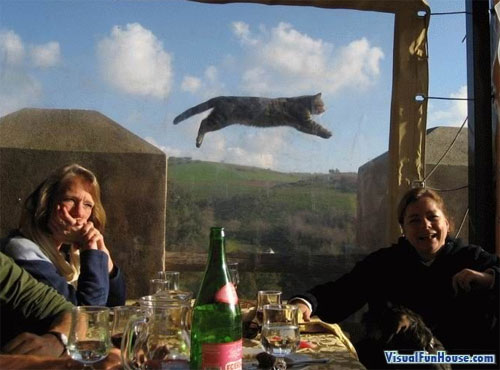
I drank a lot back then. Maybe that’s why this picture fascinates me. I found it on the web by accident, yet another cat picture, but for me it’s more than that.

It’s England. It’s summer, with friends and food and wine and a funny cat off doing the things that cats do while we laugh and talk to each other and drink and we’re not going to have to go and fight in any wars, ever, and the green hills hold us close while behind us, ignored and always there, there’s the war, waiting. The England of Kate Bush’s Lionheart. My England and yours, where it’s been  such a beautiful day and everything’s fine and yes, I  will have another glass of wine, thank-you, and maybe some cheese. This red, sorry, what were you saying?

The triangular things the cat jumps between are dragon’s teeth. That’s what they were called back then. They stop tanks. They’re too big to drive over and too solid to blow up quickly, which is why they’re still there.

I don’t know who these happily drunk girls were that afternoon nearly twenty years ago. I think that’s when it was because of the colours of the picture. Because this is my history too. I don’t know what happened to them or whether they’re still happy now. But I know the stop lines across England were peppered with these concrete blocks and pillboxes from East Anglia to Wales, to hold the German advance when the invasion came. They were in the fields where the rivers meet at Tellisford, where I used to fish when I was a boy. The past is a different country and besides so many wenches are dead now and the young men too who should have met them. But at the same time the past is still here, just behind your shoulder, the thing your cat’s jumping off. And while we have their stories, so are they.

Share Button

Lesser known facts

I’m trying to find out some things that have been forgotten, to help me with a story I’m trying to write. The address of a bakery in Bremen in 1945. The date the city was captured. I think that was May 5th, 1945, but I wasn’t there. The day a man in Czechoslovakia decided enough was enough and he was walking home, 700 kilometres, knowing at each step that if the Gestapo found him and checked his papers they wouldn’t bother with a blindfold and a last cigarette.

How do you make that decision? How do you decide that’s it, I’m gone? I’ve never been good at that and luckily my life hasn’t involved decisions as big as that. But I’d still like to find some of these things out. The web doesn’t always help, although it’s easier than it was before that was around. Some of the things you read there simply aren’t true, and some people seem to leave their brains off when they write things.

Were Germans in Hamburg in 1943 evacuated to America?

Where do you even start with that? Why do people hijack airplanes and fly them into the World Trade Centre? It’s the same sort of question. Just totally stupid and self-referential. Y’all’d sure have been all talkin’ Nazi iffen it hadn’t been fer us. And some of it’s just plain wrong.

The first shot of World War II in Europe was fired 20 years, 9 months, 19 days and 18 hours after the last shot of World War I was fired.  It was fired from the 13,000 ton German gunnery training battleship Schleswig Holstein.

Well, no. No it was not. I know this for a fact. The first shot of World War II in Europe was fired from a Webley & Scott revolver, in a Mayfair townhouse bedroom, before a ball, when a young British officer was shot. I know. Because he told me.

In one of my lives I’ve had a house in Stow on the Wold, exactly where and just at the end of the time when you might expect to find a still active officer-class survivor of World War II living there, even if he did only just survive. He lived next door to my old house next door to the huge old pub at the bottom of the square. I wish I’d kept it, but the past is another country and besides, the wench who used to call round occasionally may or may not be dead. It was quite a long time ago.

The Major, as he was when I knew him, was just a young subaltern in 1939 but his parents were stonking rich, certainly rich enough to have their own town house in Mayfair. They threw a ball specifically to celebrate their only son’s commission and he decided to celebrate by going with his chum to a decent tailor to collect their brand new dress uniforms for the ball. On their way home they collected the new pistols they were still allowed to buy for themselves in those days, as officers still did and being eighteen or so and there being no television, went to see a cowboy film before they went home to change. Dress uniforms in proper bags from the tailors and brand new heavy black pistols on their belts they went to see their film and got back to Mayfair in

A bullet nearly half an in ch across really messes-up a new dress uniform.

plenty of time to bath and change and lace Brilliantine through their hair, chummed up together in the same bedroom in the innocent manner of the times. Both of them unloaded their identical pistols and tossed the bullets onto the eiderdown while they practised their quick draw in front of the mirror, in the style of Tom Mix and Jimmy Cagney.

My neighbour was the first to get bored. War had been declared and these weren’t toys after all and there was a ball to go to and the little band was warming up downstairs and despite all of this, they were both nominally on active service, so in case the Germans invaded Mayfair that night he re-loaded his revolver and laid it on the bed before he finished dressing in his new uniform and slipped his Sam Brown belt and shiny holster on.

As his chum did, as well, but being not very old, his chum decided to have one last try at clearing leather, as if the armed might of the Wermacht would be stopped in its tracks by a teenager with a pistol who was quick on the draw.

As if in a car crash, as if in a dream, my neighbour told me how although he could see what was happening he couldn’t say anything as his chum picked up the pistol he himself had just loaded, identical to his own except for the then-unfamiliar weight of the six bullets, aimed it at him and pulled the trigger. For fun. Because it was empty.

Except as happens with guns, it wasn’t. After the enormous noise had rolled around the room and the smoke started to clear he walked downstairs, down the huge main staircase, into the room they had been going to use as the ballroom and said “I believe I’ve been shot.”

He never took part in active service, or not outside England, anyway. And that was a true story. I wish I could remember his name but really, it doesn’t matter. What does is that the history books tell just a fraction of the story.

And sometimes, talking only about the very big things instead of the small ones, they’re not true at all.

Share Button
Follow on Feedly