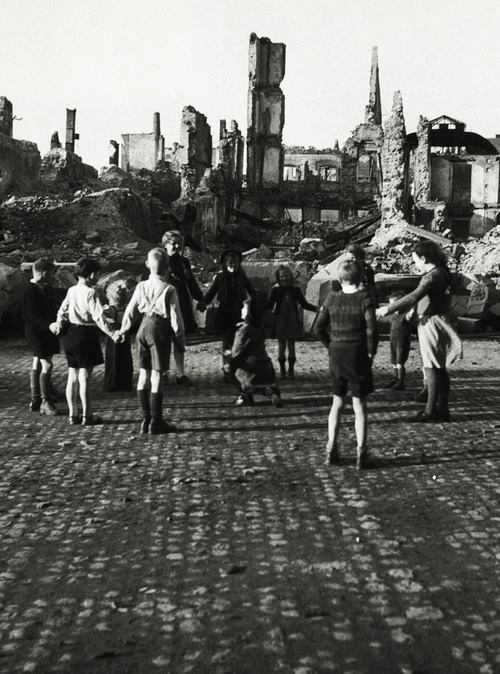
Trying to understand

German children, 1945.

Nothing you’re going to read here is new. No ground-shattering insights. No finally-revealed truths. I wish there were. There aren’t any. Almost everyone knows you shouldn’t go around killing other people and the people who don’t know that you can’t talk to anyway, because there isn’t any point.

I’ve spent the morning trying to understand people. I started reading about Dietrich Bonhoeffer, someone you might never have heard of in exactly the same way I hadn’t until this morning. He was a German Lutheran who entered the church. Two days after the Nazi Party really kicked off in a big way he started making speeches about how crap an idea Nazism was. When he tried this on the radio the broadcast went silent, not entirely surprisingly.

He went to America, to London, to Norway, he went to all sorts of places until inevitably the Gestapo killed him, just a few weeks before the end of the war. He seems to have worked for Admiral Canaris in the Abwehr, the German intelligence organisation, which was how he was able to travel so easily and why he stayed alive so long. The Abwehr seemed to have a rivalry with the Gestapo, the other intelligence operation, which was the one that eventually knocked on Bonhoeffer’s door very early one morning.

I don’t know anything about this stuff. All I knew was Bonhoeffer’s saying that people who stay silent, people who know and refuse to do anything are just as guilty as the people who do the bad things. It’s something I’ve always believed, coming from a family that lied and stayed silent about almost everything, but especially the physical and emotional abuse carried out within it. If you know and keep your mouth shut you aren’t doing nothing, you’re doing a great deal. You’re protecting the people doing it, actively. The same way that not voting protects the people you pretend you didn’t vote for when in fact you did, by not voting against them.

Spending the morning trying to find out more about all of this was not the most fun I’ve ever had. It lead straight to the ludicrous David Irving, whose ‘scientific’ analysis claiming to have found no trace of cyanide in gas chambers rested on the evidence of someone who wasn’t a scientist in the first place. There is a pile of testimony, not just from camp survivors but from guards as well, with plenty saying “it wasn’t me guv,” or they didn’t have a choice or the eternal favourite ah-yes-but-others-were-worse-than-me but none that I read this morning saying no, they weren’t gas chambers, they were just places we de-loused clothes in, or tried to fix leaky car exhaust pipes, like Kwik-Fit, that’s all it was, honest. I spent a lot of time reading through the Nizkor Project files. None of them said anything like that. The testimony read the same way other material from that time does, the same phrasing, the same ways of speaking. I’ve read a lot of it. I’ve talked to people who were there.

There was a pile of lies though. “They all knew about it” was one of them. There was no internet. When the Red Army Faction tried to radicalise Hamburg dockers in the early 1960s, telling people their phones were being tapped, they missed the middle-class point that back then, nearly twenty years later, most people still didn’t have phones. People didn’t drive to work en masse in the 1940s and look out of the window at the barbed wire fences when they stopped to do their lippy at the lights. There was something of a war on. And most people didn’t have cars.

This isn’t really about the war, although it haunted my parents’s generation and many of my teachers at school, from the primary school English teacher who insisted that the American forces ‘weren’t on our side,’ to the ex-Paratrooper PE instructor everyone respected, but for his fairness rather than his stabby/shooty ability with a Sykes-Fairbairn knife and a Sten gun. It’s about the other mass killing going on, but even that’s a nonsense.

There are plenty of mass killings going on, all over the world. We’re told about the ones that are good for us, the ones the news organisations and the government want us to know about. We’re not told in any detail  about the conflicting theories about the death of hundreds of people in an airplane over Ukraine; we’re told the Russians did it, one way or another. We’re not told where the mysterious tunnels and rocket launcher sites the IDF keeps not destroying in Gaza actually are or how many of them there are or how come the primitive rocket launchers keep manufacturing themselves in Gaza when there isn’t any electricity any more, no port, no airport and no way in or out. We’re not told why it’s ok to invade other countries like Iraq and totally destroy infrastructure there, then rebuild it and give the reconstruction contracts to the Vice-President’s company without competitive tender. We’re told what we need to know. And it leaves me with questions.

If the Nazis set-out to kill every Jew in the Riech, why did they leave any? Why did they start winding the programme down in 1943? Why did they do it in the first place? Why wouldn’t Churchill and the British government have any serious talk with Bonhoeffer? Or with Hess, if it was in fact Rudolf Hess who turned up in Scotland? What did Hitler and his best political mates have against Jews? Why don’t we all know about the German resistance, not just about Bonhoeffer but the doomed White Rose group or at the other end of the social scale the Eidelweiss Pirates, the working class Hamburg kids who used to hunt Hitler Youth recruits and beat them up?  Why is it ok to occupy somewhere illegally in the face of more UN resolutions than were ever passed against any other country and the US, the fearless defender of Gahd, mom and democracy, whose troops marched off to Iraq fatuously declaring they were ‘honour bound defending freedom’ has absolutely nothing to say about it?

Unidentified US pilot at Leiston, between June 1943-45. The puppy sits on a drop-tank.

Why? Why can’t we be told and why to any of it anyway? Is it just what we do, us humans, the worst, most adaptive destructive monkeys?

I think it is. A few years ago I met a man who was then in his eighties, who’d flown Mustang fighters for the USAAF from Leiston in Suffolk, an airfield a few miles from my house. He was from Ohio and spoke with that slow, gentle Mid-West tone that belied the fact that he’d been trained specifically to kill people, for no other purpose. He stayed in my house for ten days for two summers. There was a lot of swing music. A lot of beer and memory.

He told me a lot of things about the closing days of the war, how he’d been sent to Germany along with the rest of his squadron just a few weeks after the end of the war, how he’d had one date with a German girl and decided he’d live longer if he didn’t after someone opened up on him with a sub-machine gun just after he kissed her goodnight. He never found who it was after he spent an hour hiding in a dark wood until he was pretty sure the ex had gone. He told me about sleeping with a loaded .45 under his pillow after leftover German guerillas calling themselves Werewolves had promised to sneak into the allied bases and kill the invaders in their beds. He told me about a time when his flight had attacked four German aircraft and destroyed all of them and how he felt guilty admiring the incredible beauty of the blue-green flash of two of the aircraft as they exploded. How at least the two young men inside died instantly, unlike the other two who had a minute or more to fall to earth with the pieces of their aircraft falling around them.

He told me about the camp he’d seen.

He told me about piles of bodies. It doesn’t make a penny’s-worth of difference whether there were a hundred or a thousand or ten million, or whether they died from gas or bullets or typhoid or starvation. None of them needed to. None of them should have. He told me about how his squadron saw this and how they decided to go into the nearest town. They rounded up every German they could find at gunpoint and marched them through the camp, young and old, so nobody could say afterwards that they didn’t know. The mayor of the little town killed himself soon after that. When the last German had been lead through the camp the young Americans had another conversation. What say they stop by the armoury and just go back into town and kill every last one of those bastards? This was a serious discussion item. A very senior officer had to stop it because a lot of the junior officers were onboard with the idea. It was a popular theme.

So I can understand people being so sickened that they think the only thing to do is to do the same thing. I can’t understand why people need to lie about what they were doing, or what they intend to do. People like David Irving, American Presidents, the IDF PR department I can’t understand at all.



Share Button

Walcot Nation

I lived in Bath a long time ago. In those days a lot of the buildings were black with 200 years of soot from coal fires but it was a bustling, busy place. It still is, but where once Walcot Street was full of combat jackets and patchouli oil, today it’s Range-Rover parking and shops selling bathroom taps for half a term’s student grant. There was a fabulous market there on Saturdays if you ever needed a cheap car radio, definitely not stolen, oh dear me no. You tested it by clipping a car battery to the cut power lead once the guy selling it had peeled back the insulation, and taping another lead to any speaker lying around the stall. Bath has changed. This poem is a little of how it was.

haile selassie house

A WESTERN SUN

I hear that song, still feel the heat of a western sun

Those years ago but now –  and it’s always now, in my head,

Always the time I first heard it aged seventeen

And my, those ten years just flew by, didn’t they?

That’s just when it was.

I can see the blurred flag flapping in slow motion

Snapping in the damp wind of my false memories

Of long haired men marching to the war we despised

But that was someone else’s war ten years before,

Something that was all in our minds

As we wandered up Walcot Street to the Hat & Feathers,

Leather jackets and silk scarves, the day of the festival

A sweat salt tang stayed on our lips

Our battle salve patchouli hazed our dreams

That blurred afternoon and back then we dared to dream

Not about BMWs and ISAs or chartered accountancy

Or a thrilling carer in actuarial statistics and dear God

If I’d only known that the loose connections, the loops

Of if-this-then-that in my head, the spurting synapses undammed

By dope and cursed by my teachers at a country school

Could have bought me half the grey stone town I grew up in

By now. Probably. But stop. But stop.

Never go down this road

Where half the streetlights aren’t working,

Lit only by the dipped beam of my memory

Coming from a car I haven’t had for twenty years

A faulty bulb flickering whenever I put the wipers on.

You know that if you take this track you’ll only get a hundred yards or so

Until a cold girl in a warm car, silhouetted against the trees

Lit like the backdrop of a play, so cold outside;

The girl in the sheepskin coat will say

‘What if there’s nothing there, the other side of the gate?’

The second it appears in the headlights.

Even then you felt her voice would hunt your dreams,

Sniffing you out while you sleep, wherever you hide at night.

But that flag, the flapping ripple of cloth,

And the hair blown across her forehead and somewhere

The taste of tears as well as the kiss still on her lips;

The army coats and the smell of goats when her bag got rained on;

The time she did, she really did tie red ribbons in her hair

And small golden bells. They looked golden anyway,

Borrowed from the mirror on her dresser,

Bought from a headshop one Saturday afternoon in Bath.

Can you believe those words, now?

This long since Princess Margaret and her happy dusted chums

Played with a restaurant and a farm to feed it, up on the Swindon road,

The way Peter Starstedt said it then, just for a laugh, ah ha ha.

Parsenn Sally. Later, in the eighties a waitress paused

When a customer pushed his napkin to the floor,

Measuring the length of her skirt as she stopped

Looked to the audience, fifty or so of us willing

To show the colour of our money,

Waiting to see the colour of her underwear,

A fiver on white, ten on black,

Wild bets on something awful like cerise

As she put a finger mocking to her lips, shook her head,

Bent her knees a little, just to tease, then flexed her leg,

Kicked the napkin under the nearest table

To a round of applause.

“Another bottle of fitou over here, if you would”

The appreciative click of credit cards on glass tables.

“And have one for you.”

Bath where Regency houses lured London workers with their siren song

Bath where water streamed down Royal Crescent walls,

The lead flashing long gone, during the war probably,

When patriotic householders bore the loss not just of sons

But irreplaceably the 1820s cast iron trellices, rococco awnings,

Gates and railings cropped and sawn and smelted to beat the Hun,

Our loss; as if cast iron Spitfires ever flew

Or steel swallows ever perched in Larkhall Mansions.

Scars from bomb splinters still pock the stonework near M&S,

The slashed birthmark of our time

Still there if you know where to look

Past the ghosts of open markets, joss-sticks and motorcycles

Cafes full of lean dogs and coke stoves,

Not a baby buggy in sight.  All of this emblazoned on our tattered flag.

All of this our banner as we marched

Under the stained pennants of our duvets towards now.

Come the revolution in Walcot Street.

Come the glorious day.

We didn’t see the bathroom showrooms coming.

We thought it would turn out ok.


Share Button

Protection

I thought of a girlfriend or a young wife and a State Trooper knocking in the middle of the night..."
“I thought of a girlfriend or a young wife and a State Trooper knocking in the middle of the night…” Ok, so I didn’t write it. Want a fight about it?

I wrote this last winter. It was freezing and my car was telling me all kinds of bad things, none of which ever happened. The things that did my car had nothing to say about.


Protection

Strap in and turn the key

Check the warning lights,

Sale behind the side impact protection bars,

The crumple zone, the anti-dive seatbelt

The whiplash padding on the head-restraint,

The lights on the dashboard telling me my belt is unfastened,

But I’m reversing as it tells me too.

The mirror’s heating and the black ice warning snowflake

Not showing white on the glass somehow this cold morning

The clamour of the reversing sensor,

Another light to tell me the airbag will work

All of this telling me I won’t get hurt.

All of these coats and gloves and deadlocked doors,

The shatterproof glass, all of this protection

Around me and your empty seat

And still one word from you or

A single glance could rip my heart.

Share Button

All Of Your S**t

"MILF seeks studz #lolI"
“Foxy MILF 28 seeks studz #lols”

This tender, romantic little poem was inspired by an ad I once saw in the Personals, long before there were things like www.swingingheaven.com that nobody knows about anyway so I don’t know why I mentioned it really.

The ad went on and on and on, about how this poor woman loved her children more than life itself, how she’d been left on her own with them and how she’d never let anyone get between her and her most precious darlings. This was a Personals ad, don’t forget. Maybe not the best place to do all that. Right at the end after she’d bled all over the page, she cracked the best pay-off line I’ve ever heard:

“I’m looking for a man without any baggage.”

Without any sense of irony too, obviously. I hope she ended-up with the American she was looking for. It stuck in my head, the way things do, until I wrote her ad again.


All Of Your S**t

I’m looking for someone without any baggage

I’m a man/woman/couple looking for

A fun reliable person/partner/soulmate,

Someone tall/short and dark/light

Someone funny/serious and adventurous

Who likes staying at home and going out

Just chilling and doing the same things.

They say opposites attract. LOL.

I love my children, my family, my job, my home, my car

I’d lay down my life for them or never forgive them

Or someone for getting between me and them.

I love my pets and I don’t want any ties right now.

I like walking on beaches in the mountains.

I love going on Citybreaks in the countryside.

I want someone to be there for me when I need them

And I can’t handle anything heavy right now.

I want someone to build a future together.

I love having no responsibilities

And caring and going away whenever I like.

I love staying at home. I’m looking for a life partner,

A serious relationship, a one-night stand.

Who knows? Let’s see. Fun.

I’m married, single, divorced, separated,

Just looking and widowed;

It’s complicated. Delete as appropriate.

Or delete me as inappropriate.

Friend me. Chat. TXT. IM me.

Delete my posts on your timeline,

Block my profile and change your privacy settings

Even as you change mine, forever and ever

Until the next time.

Mark me as flagged until the Xs disappears from your MSGS

And quickly then the TXTS get shorter and less often

Until sooner than you thought

On the screen there’s no reply at all

And quite finally, without appeal and irrevocably

You just unfriend me.

So I’m looking for someone without any baggage.


October 2013
 
Share Button

Late Flowering Lust

“With brandy-certain aim” described my own technique, once upon a time. It’s not nice. but Betjeman’s poems weren’t about nice. They were about real life, a vision of England much more real than many imagine, a summer’s meadow where the picnic usually has wasps.


John-Betjeman-Quotes-2

So because I like you all so much, here, fantastically but true, is nearly a whole hour of Betjeman set not only to music but to film.

Things to note are my mother at 2:30 (not actually her, but it may as well have been) and the literal dance macabre late at the party.

As for the late-flowering lust stuff, obviously, I couldn’t possibly comment.

And btw, the teddy bear in Brideshead was Betjeman’s. He was nothing like Sebastian n any other respect, although perhaps he wished he was.

Share Button

Me and Edith Sitwell

It was just a name I’d heard, the way you do. One of The Pancakes turned me on to her, as we used to say, when it didn’t mean that.

“You should hear her stuff on You Tube.  It’s like the stuff you do.”

edith sitwell
“Apparently my stuff’s like Carl Bennett’s.”

Hmm. I’m not sure Still Falls The Rain is anything like the stuff I do, frankly. I can feel the pain in it. I can’t go along with the thing that says ‘my invisible friend says somehow all this is alright.’ Mrs Miniver I can handle. Mrs Masochist not so much.

I thought maybe she had something to do with the Mitfords and all the rest of those semi-mythical people the British idolise primarily because they’re rich, have dysfunctional families and usually have something wrong with them. It’s our national obsession, that and living in the kind of stone house that points to slavery or tobacco. Of course,  if you want the really biggest, most absolutely Yah kind of house, sorry, hise, you have to kill lots of foreigners. Absolutely loads of them if you want something like Blenheim Palace. Apparently the Duke of Marlborough went off to war, his wife built the house (and yes, me too. I’d really, really like to have seen her with a hod full of bricks over her shoulder, or having a sausage sarnie while she read Ye Sunne, wiping the brown sauce off her hands on the leg of her jeans) and he shagged her in his riding boots when he got back. Although why she was wearing his riding boots instead of her own was never made clear.

But anyway, Edith Sitwell ticked all the boxes. Allegedly. A hundred and one years on and we seem to have a lot in common. “Sitwell published poetry, some of it abstract and set to music. With her dramatic style and exotic costumes, she was sometimes labelled a poseur, but her work was also praised.”

My step-sister lived around the corner from where Edith lived, admittedly at a different time, so another tenuous link there, I think you’d have to agree. Apart from the rich thing. I’ve never had the knack. Like all True Brits, nor did Edith Sitwell. She inherited it.  Oldest child and only daughter of a baronet who was fantastically “an expert on genealogy and landscaping,” two of the most irrelevant things you could ever aspire to be an expert in. Her titled mother claimed descent from the Plantagenets, but rather more medieval money seemed to have come with her ladyship than attached itself to  a friend of mine who grew up in Farnborough who equally claims descent from them.

Edith ticked the dysfunctional family box pretty well, being locked into a metal cage to straighten her spine, which she doubted was ever bent in the first place. She could probably knuckle-bump Eminem too, whose mother pretended he had something wrong with him other than just hating her, something any normal male teenager is supposed to do anyway. Unlike Eminem’s mum and rather to his disappointment, obviously, she ended up in a wheelchair with Marfan Syndrome and died of a brain haemorrhage

So me, Edith Sitwell and Eminem. We’ve got a lot in common. Maybe that’s why the comment I hear about my stuff is it’s good. You do know it’s insane, don’t you. But it’s good. And I can live with that. Unlike Poetry Voice.

Share Button

Unhappening

After work, the happy volunteers gathered on top of the tower.   Quite. Some nights, anyway.
After work, the happy volunteers gathered on top of the tower. Quite. Some nights, anyway.

Long, long ago when if not the world then at least I was young, or younger, anyway, I lived on a kibbutz. You sort of had to at my school if you’d been on the sailing team.

Yes, I know how that sounds. Thanks.

It wasn’t that posh. We had two Enterprises and two Mirrors, both types wooden dinghies that might have been made in someone’s garage and many of them were. We sailed on a lake that had been a gravel pit next to Westbury railway station. We had two teachers looking after us, both of them a bit like the kids who ended-up sailing, nice, but none of us really fitted in with the school. The female teacher had been through a divorce from another member of staff. We knew something wasn’t right when we saw the obviously not happy couple arrive at school one morning in their (probably his, in those  days) Escort Mexico or whatever it was that blokes having second thoughts went and bought on HP after they’d grown a Zapata moustache. They parked and got out and kissed briefly before they each went their separate ways to their different classes.

Just as a tip, if you want to convince IIIa everything is fine and dandy in your marriage, maybe not both wipe your lips simultaneously as you turn away. It stays with me still, that symbol of a gritted teeth let’s-keep-this-civilised break-up in progress. Hanging on in quiet desperation might have been the English way once. Times were changing.

The other teacher was another misfit, one of the nicest people I’ve ever known. Someone you could trust completely. When one of the other pupils’ father keeled over dead it was this teacher who stepped in quietly as someone who was always there. You didn’t mess him about. You didn’t even want to, because he was totally fair. Unlike the other PE teacher, who was such an utter arse that he spent his lunchtime driving around the town looking through pub windows to see who was where and who shouldn’t be (some of us were eighteen and there wasn’t a school rule about not going to pubs), the sailing PE teacher was just straight down the line. He was usually smiling and quiet. I think I saw him smoking a couple of times. Certainly he didn’t bother asking stupid questions about why when the dinghies went the other side of the island they apparently all hit a headwind and huge clouds of Old Holborn rolled over the lake. At least. But then, he didn’t need to prove anything. He’d been a paratrooper in The War.

Sorry, I’ll type that again. The good PE teacher, the un-ostentatious non-arse one, the one who smiled, had been a paratrooper in the war. Not Northern Ireland Parachute Regiment beating up kids with sticks. Arnhem. D-Day. Unimaginably out in front. You don’t get much more rock than that, really. He probably gave the other one an inferiority complex just by turning up.

So anyway, as nominal Captain of the sailing team it was my sacred duty to go to kibbutz after school. After I left, you understand. It would have been too far to get back every morning, in those days.

I went out with Project 67. I went up to that London for the interview and found people with Walther PPKs stuck down their belt in an office in St Johns Wood hidden behind what looked like a brick wall and clearly wasn’t, all covered by CCTV. It wasn’t now. They only had CCTV on James Bond films back then. James Bond films and spook cover offices in St Johns Wood.  It was my first taste of ‘we can do what we like.’ I got more familiar with that as the next few months rolled on. I didn’t know then that the .22 Walther PPK was a favourite Mossad tool for when words just weren’t enough.

I went out there for about two months. I was 19. It seemed a lot longer, but things do when a month is a much bigger proportion of the life you’ve had so far. Revivim was a pile of nothing in the middle of the Sinai desert. It was nothing like the catalogue of lies we’d been told to get us out there. In writing in my brochure was stuff about how you could all get together and borrow a kibbutz car and go into town. There were no kibbutz cars. ‘Town’ was Be’er Sheba, 36 km away and apart from the bar at the bus station there wasn’t anything to do there except not buy the green tobacco that looked like dope but wasn’t in the market and look at the beggars with twisted legs where they sold the live chickens. It wasn’t much like Trowbridge at all, somehow.

They saved the biggest lie for the night the kibbutz was attacked. We knew there were armed guards around every night. Because of TV we pretty much knew what a full magazine of 9mm going off sounded like, but it wasn’t a sound we’d expected to hear as we didn’t have a TV. We all stopped what we were doing and piled out of our huts to stand there illuminated in the parachute flares that were drifting down. Our PE teacher would have told us to get back inside and lie on the floor, the same way I’d tell people now, but he wasn’t there.

There wasn’t any more gunfire. Some older people from the kibbutz self-importantly turned up with Uzi sub-machine guns in their hands, rounded us up and marched us off without any explanation. What’s happening? Nothing. Where are we going? The shelter. What shelter?

Good question, as it turned out. We were all marched down some steps behind a locked steel door on the tennis court, where it turned out the brick hut wasn’t a toolshed after all, but the top of a flight of steep stairs. We all sat there for about an hour. What’s happening? Still nothing.

Eventually we were sent back to our huts. What’s happening? Nothing. Everyone wasn’t talking about it at breakfast. The volunteers were. The people who lived on the kibbutz weren’t. Even when you asked them directly.

So what happened last night?

What do you mean?

We all had to go to the shelter.

There is no shelter.

The gunfire.

There was no gunfire.

The parachute flares? The lights in the sky?

You were dreaming. Nothing happened.

After about an hour we were all sent back to bed. It’s safe. What is? Nothing.

After about two weeks someone found out what had happened. The kibbutz guards that night were fifteen years old. Apparently it was a really good idea to give fifteen year olds loaded sub-machine guns to stick in the front basket on their bicycles. It was night-time, nothing was happening because it never did unless you went spying on who was using the old huts who shouldn’t have been but hey, you’re fifteen and you’ve got an Uzi. Obviously the best thing to do is check the safety catch is on. Not by feeling it with your thumb. Not by taking your hand off the pistol-grip and making sure the web of your fingers isn’t pressing into the back of the handle. No. You’re fifteen.  So you hold the thing firmly, (disengaging the grip safety) and pull the trigger. And before you can get your finger off the trigger, because who would have thought that would happen, 30 rounds of 9mm have streaked across the sky at 1200 feet per second.

But luckily, nobody thought it. Because they were kibbutz people. And kibbutz people don’t make mistakes. So luckily it never happened at all. Except it did. Just like the two Arab villages which were bulldozed to make way for the kibbutz.

Share Button

28%

Dear Chinese people,


Thank-you. I mean, it’s really, really flattering that you like my stuff so much that 28.something percent of all the visits to my website are from China.

It’s truly humbling that my modest efforts to entertain people with posts about Germany and poetry and historically not shagging who I want to or not enough or not any more find their way all around the world to the high-rises of Canton and little thatched houses by a river all that way away.

It’s really nice that you take an interest. No, really it is.

But you aren’t, are you? You really aren’t into my Songs Without Music concept. You don’t really care about the Eidelweiss Pirates or Milorg or White Rose or  bicycles (you’re getting rid of those) or any of my other obsessions I litter this site up with.

So WTF is it you actually WANT here? You never leave a comment. You certainly never buy my books. You don’t even charter a plane and come to my gigs, and there are certainly enough of you to make that an economic proposition.

You’re spying, aren’t you? You’re not even real people, just web bots trawling through every new post that goes on WordPress from anybody at all, looking to see if there’s something you can steal. It’s ok. My government wants to roll over and let you tickle its tummy in case you want to buy more stuff they’re giving away, so they won’t be doing anything about it.

So dear 28.7% of all the visitors to this site, please feel free. Immerse yourselves in dim memories and recreations and filterings and yearnings for people you never knew, people who don’t actually exist outside the prism of my creating them. Alternatively you could get off your collective farm arses and do something yourselves. But getting a web-bot to do your scamming is probably a bit easier, isn’t it?

Be lucky. Oh and stop killing the tigers. Eating them doesn’t give you a bigger cock after all.


Share Button

Poetry Voice

It’s always put me off, and not just me. That pompous ‘listen to me, this is Culture,’ schtick that always reminds me of Kenneth Williams playing his best roles, the waspish ageing queen desperately trying to hide everything behind a veneer of respectability, as if being who you are wasn’t respectable; the English tragedy, that if you were gay it wasn’t just not respectable but you were going to jail for it if it frightened the horses.

I wasn’t and am not gay, but I’m old enough to remember teachers and church people who looking back now, had a lot more in common with Kenneth Williams’s pastiches than they ever did with my life. Back then I thought it was – they were – about having more money than we did. But it wasn’t, or not entirely. It was about being afraid, afraid that however much money you had, one word, one accidentally public peck on the cheek, one hand on another’s shoulder a little too long and you were going to the Big House and nobody decent would ever speak to you again.

If we’ve done nothing else (and I won’t even bother saying ‘discuss’) then at least, at the very, very least, we’ve stopped doing that within the span of my lifetime. And that’s got to count for something.

So here it is:


Poetry Voice

All my life I’ve tried to avoid it;

At school, on the radio, standing here doing it,

The sound of ‘listen to me, this is important

And cultural and noble and pure and true

Because I’m doing Poetry Voice.’

Just for you, dear audience. Wherever you are.

They’re all long words, drawn out vowel sounds and pauses

Sometimes in the most

Unlikely places and words like stentorian

And o’er and appeals to the muse.

And maybe it’s me.

I saw an elephant fly and made a rubber band

But I never saw a Muse. Not once.

I’ve walked o’er dale and hill

But I never saw a daffodil except in someone’s garden.

That’s Poetry Voice – it’s about chasing the rhymes and using words

That nobody’s used since the start of time like this and I don’t:

The sea-birds scream’d as they wheel’d round,
And there was joyaunce in their sound.

Joyaunce? Are you absolutely sure that’s what it was?

I walked the field where Coleridge was lost as a boy.

I did this. I went there.

And that’s what it is.  A field. It didn’t fill me with joy somehow.

There’s nothing there. Not even chickens.

The words do it or they don’t.

And the best thing you can do

When you’re standing up here saying these things,

Is cross your fingers and hope your own voice

Doesn’t get in the way, doesn’t put itself

Between the words

And people’s hearts.

You have to assume they have minds.

In fact you don’t. That’s what Poetry Voice is all about,

An appeal to higher senses, tickets on the door,

Volvos in the parking bays, Day-glo vests on the ushers

Guiding you to your aisle, spectral in the gleam of the stage lights

White hair and false teeth flaring in the ultra-violet light.

So if I should die think only this of me

That in some far corner of a foreign bar

I’ll be standing behind a microphone,

Still too lazy to learn my own words,

Still so rocknroll that I have to wear spectacles

To read these songs, trying to right these wrongs

That really, nobody cares about.

Except you’re all here, listening,

So maybe part of that’s wrong.

But I’m still not doing Poetry Voice.

Share Button

It’s a guy thing

For about 400 years or more, any man who wanted to look clean shaven had to shave the same way, with a straight blade. There weren’t any safety razors or electrics or Bics. And yes, thank-you, I do actually know it’s a trade name and so is Hoover, so don’t get cute when you know what I mean. There weren’s any cut-throat razors either, because there was never any such thing until Frederick and Oto Kampfe started lying about them to sell disposable razor blades in 1880, building on the 1847 Henson patent, which went on rather disturbingly about common hoes.  Even today Wikipedia (surprise!!) repeats the same tired old meme about straight-blades:

“The initial purpose of these protective devices was to reduce the level of skill needed for injury-free shaving, thereby reducing the reliance on professional barbers for providing that service and raising grooming standards.”

Meditation aids: Swedish steel blade and a badger brush. OK. I know. It was a present, alright? I
Meditation aids: Swedish steel blade and a badger brush. OK. I know. It was a present, alright? I know…….

So many Thatcherite plus-points in such a short sentence, and all ostensibly about shaving. Except as with most things in life, it’s much, much wider than it looks.

Let’s start with reducing the level of skill. Always seen as a massive bonus, it’s the next part that’s the really big lie snuck in there while you were thinking about people like Thomas Helliker. The bizarrely named King Camp Gillette whose parents must have really, really not wanted him at all patented his double-edged disposable razor in 1904. In the First World War he got a contract to supply the US Army with his razors and each soldier was allowed to keep his razor if he survived. Most of the three million Americans involved did and suddenly created a market not just for razors but much more important for a manufacturer, a demand for a new blade at least once a week. Gillette invented high-tempered steel litter.

Some older American houses still have a steel box set in the bathroom wall, the place to dump your old blunt blades. It’s not openable; in tune with the disposability of the blades, they thought that by the time the blade box was full the house would be disposable too. See any snags with this reasoning so far? One planet. Don’t spend it all at once.

So far as I know the German army issued straight-blades through World War Two, but the British Army had already switched. Within not very long, most men had forgotten two things almost every man had known for hundreds of years; how to wash his face and how to sharpen a straight blade. Obviously too, everyone was spending more on disposable blades and calling it saving money. A brand-new straight blade will cost from around £60 on up. The most expensive I’ve seen was nearly £800 and it will give the same shave as the cheaper one. The look of it was a different thing altogether. The cheaper one will last the same length of time as the expensive one too: the rest of your life. You’ll spend £60 on the cheapest disposables in the first year.

Reducing consumer reliance on anyone skilled, anyone who actually knows anything, anyone who actually looks after you even if you do have to pay them for it is always another neo-Con obsession. You shouldn’t BE looked after. You should scurry around in the dim light of a winter’s morning, splashing your stupid unloved face with cold water before you scrape up and down with a three-day old plastic Bic before you get out of the door with a piece of toast still sticking out of your mouth, all ready to spend another day commuting and working and earning and consuming. WTF do you want looking after for? Don’t you know why you’re even ON this planet in the first place?

And raising grooming standards. Mrs Thatcher was always very keen on high grooming standards. She was quite keen on saying things that weren’t true either (‘we don’t talk to terrorists’ just for one) and that’s a great one. How scraping your face with a plastic disposable is evidence of raised grooming standards is one of those great mysteries. Like if the IRA had plenty of people ready to die for the cause, how come the Brighton Bomb didn’t get its prime target?

Anyway.  Sweeney Todd was a barber in London who was reputed to cut his victim’s throats and dispose of the bodies by turning them into pie fillings. More lies here, I’m afraid. There never was a Sweeney Todd, outside Victorian melodrama. If you actually did cut someone’s throat with a razor after the most stupid name going, which is perfectly possible but there is – trust me – no way you could possibly do it by accident, then there would be literally fountains of blood splattering six feet up the walls. Unless it was really, really foggy people might notice, just a bit. And even then they’d smell it anyway.

For me, that’s the silliest part. I’ve always but always cut myself with ‘safety’ razors. I hardly ever do with a straight blade. The idea that you could cut your throat is just stupid. You could. But not by accident. The idea alone stops you doing it, because when you start off you’ll cut yourself once. And you won’t even feel it. That’s the odd part. You’ll see the blood bright red through the lather or if you’ve been utterly stupid enough to run a finger along the blade to see if it’s sharp you’ll have seen but again not felt that actually, bizarrely, things are called razor-sharp because that’s what razors generally are and the thought alone sharpens you up of a morning, a bit like cycling or riding a motor-cycle. Shaving the old way isn’t a passive thing. You have to be involved. It’s not about choice.

First you need a decent razor, so you’ll do the thing everyone does and waste more than a good razor would have cost buying cheap crap ones off eBay. The only ones you’ll find at boot sales usually have chunks missing out of the blade where someone tried to sharpen a pencil or use it as a penknife. If you actually used one like this they say men with scars have more character, so it’s not all bad. Except it will have been and you definitely will have felt that.

Once you’ve got your razor you need to sharpen it and this is where the serious Me-Time comes in. Wierd stuff happens to the edge of the blade on a razor. After you shave the metal grows, or at least it uncurls from the slight bend the whiskers put in it before they got shaved off. Trust me on this. Not a foot or so like a magic sword, but at microscope level. If the ultra-utter edge of the blade has curled over then obviously it’s going to be blunt, so you have to rub it on a leather strop, pulling away from you with the sharp bit of the blade towards you, then turn it over and pull it back towards you. You’ll see why that’s important about now. But you can’t do that for about 24 hours after you’ve shaved with it or the edge won’t be right. Which is why rich folk and barbers used to have seven razors, one for every day of the week.

If you’re really into it (and today you’ll have to be because you won’t find an old-fashioned barber to do it for you because they all have to use disposable straight blades) you’ll buy a stone and hone the razor on that every couple of months. And in between use another leather strop with abrasive paste on it between times, not forgetting to dry it off each time you use it and oil it if you’re not going to use it for a couple of days. By which time, left alone, sometimes it’ll just go blunt anyway. Because it will.

The shaving part is more involved too. You need to get your face warm. Barbers do it with hot towels and it feels great. Soothing. Relaxing. As if you’re rich and someone cares. Then wash your face with soap and wash it all off. Then wash your face with soap and don’t wash it off, but lather up some different shaving soap with a brush and put that on. You’ve seen it on the films. And don’t forget to get the brush nice and hot first. You’ll notice the difference. Then do it. Use a decent mirror and it’ll be fine. Don’t lay it flat on your skin. Don’t put the blade at right angles to the cut. And for God’s sake don’t ever cut in the direction of the blade, because you’ll go straight through to your teeth before you know what’s happened. Think about that and you’ll never go wrong.

Then do it again. Then do it again the other direction. And dab what soap there is off, then cold water wash and moisturise and then perhaps some aftershave. And feel like a king, centred, focussed and truly, definitely sharper. Because you’ve been concentrating. Doing the thing you’re not supposed to do in a big consumer society. Not the not-buying-disposable-stuff every couple of days.

You just did the really bad consumer thing. For about fifteen minutes you shut everything else out. You meditated. You just focussed entirely on you.

It’s a new day. It’s a new life. And it feels good.


Share Button
Follow on Feedly