Bearing down

Before, looking a bit needy. The boat, not me.

I went down to the boat again today to make a start on the renovations. I’m also trying to take my mind off the small and potentially fatal issue of how I’m going to get the boat around to Aldeburgh Yacht Club, which doesn’t sound too threatening in and of itself, but it means going out of the mouth of the Deben and into Orford Haven.

The entrance to the River Deben is protected by a shifting shingle bar that often has less than one metre over it at LW springs. The bar is dangerous in heavy seas and especially in strong onshore winds.

That’s the going out bit. About four miles north at Hollesley you have much the same thing, but in reverse.

The bar at the entrance to the river is formed by a shifting bank of shingle. Depths are subject to frequent change. Up to date local information should always be obtained before making an entrance. Broken water on the bar often looks frightening but is to be expected. Entrance should never be attempted in bad weather, especially during onshore winds.

This stuff can actually kill you. Either way, the boat isn’t going to make itself look nice so I thought I’d better make a start and get sanding down. I can’t find where my extension lead is, so I had to do it by hand. It didn’t take as long as I thought it would. I went around the whole boat with a scraper first, to get rid of any obviously flaking paint or varnish. There wasn’t much.

I got a phone call from a job agency about Tuesday, confirming. They were going to send me some background information too.

Then I made a start on the decks. Knee pads helped a lot, new protective gloves too. I got another phone call, from someone who made me smile and my heart lift. After we’d talked and got in that silly muddle about ringing off, each saying goodbye about three times like teenagers, although we really, truly aren’t, after I’d made the promise I always make to myself when that person rings me, if this job works out, I got back to sanding the afterdeck again.

After. About an hour and a half after.

I worked on this for about two hours, although with thinking breaks and phone calls and a trip to the shops for work gloves I was there for about three and a bit hours all told. The wind was coming up and it looked like rain with lights going on in the car-park by the station when I left. It was cold. I didn’t realise how cold I was until I walked past my car, not thinking. Careful.

I got fish and chips as it’s Friday and went home to eat them. Opening my email the agency has sent background information about the job I’m being interviewed for on Tuesday. I ache from sanding and bending and kneeling; I’m not used to this. The company has also sent a test. Literally. They sent it at 17:23 on a Friday. They want it by 23:00 Sunday, which seems remarkably precise, so they can have it for first thing Monday and review it for the interview. Part of me says they’re joking. I don’t even work for them yet and they want me to start on something through the weekend when they’ve known about this for two days. I can’t do it tomorrow because I’m helping someone demonstrate how to smoke fish, and although that sounds a bit optional I said I’d do it, so it isn’t. That’s important to me. Sunday. I’ll have to do it on Sunday and not go and work on the boat. I’m also supposed to be going to London on Sunday because I have to go and follow a tour guide around all of Monday, starting 0830 in Wembley.

I like jobs where you can see what you've actually done. The left half of the picture for example. Starboard side if you insist.
I like jobs where you can see what you’ve actually done. The left half of the picture for example. Starboard side if you insist.

But it’ll get done. Things do. And I want this job so I can keep the promise I made when I rang off on the phone. And anyway, the boat is getting done. The paint is all ordered and on its way and if the varnish isn’t because I want to use Tonkinoise instead, although what that is will have to be left until another day because I’m tired now, then all of that can be done when it’s actually in the water. And I can decide whether to get absolutely all the old varnish off or just re-varnish over the top of it later as well.

Assuming I survive the trip round to Aldeburgh. If I don’t then it won’t matter anyway but that’s going to be fine. The fish will get smoked. The test will get done. The sound edits for a demo I was supposed to finish today will get done soon, possibly on Sunday on the train. That would work. The interview….I will just have to do my best.  Today’s results made the job worth doing. Tomorrows – well, tomorrow is another day. Today is all you ever have. My day has been a happy one. I made somebody else smile too. I could hear it in her voice.

 

Share Button

Day One: The Reckoning

imag0253
Looking aft. As we salty sailor boys have it. As it were.

I went down to see the boat today. My boat. The boat that is mine. I took some water and bread and cheese. I’m taking some apples tomorrow because frankly, that all got a bit unduly Spartan but never mind. I opened all the hatches and got some air running through the boat and got everything that was damp out in the wind where it could dry out while I took stock of things.

I was just working out the tasks, what’s going to need doing first. I’ve given myself ten days to get her clean and tidy and in the water, which should be a reasonable time-frame. Should be. Except no sooner had I sat down in the sun with the main hatch open, sitting on the step so I could see out but protected from the wind by the coachroof in a really nice, comfortable spot I can see myself using a lot, the phone rang. Of course I had my phone with me. Everyone does. Even around here, where phones don’t always work.

I’d thought the boat needed a cooker and a sink, but when I had a good look around there was already a sink there, under a chopping board that disguised it. There’s a twin-burner paraffin stove with an oven in the boatyard shop. I’ll measure the space tomorrow.

Urgent stuff to do? I need to make a little wooden box out of ply to cover an unsightly hole you can see on the right hand side of the top picture, where the depth gauge display has been cut into the wood not very neatly. Some bolts need trimming so they don’t stick out, because it’s ugly when they do. There’s a bit of wet rot that needs stopping before it goes any further, but that’s what wet rot glue is for. Mostly it just needs sanding, a new coat of anti-foul to keep the weeds off, new paint to cover the few scratches where someone got a bit too enthusiastic about mooring and varnish to replace the old varnish.

Yacht varnish is a total waste of time, in my experience, so I’m not going to do it. Instead, I’m going to use stuff called Tonkinoise which the French Navy used to use out east, as we say in Woodbridge. It’s not varnish. It goes deep into the wood rather than sitting on top of it, so it doesn’t flake off again every single year. Unlike varnish.

Mind your head. I think this is the reason these classic little yachts are out of fashion. They were designed for sailing, not an aerobics trampoline class.

So sanding tomorrow, but I’d better order the anti-foul and the paint and the Tonkinoise first as that’s going to take a few days to arrive.

I can’t decide whether to use a power sander or not. Somehow it seems a bit like cheating, but there’s quite a bit of hull to sand so maybe I’ll do the decks and the exposed wood by hand and everything else with a sander.

Either way it’s going to be a long day and there’s some other stuff to do, because the phone ringing meant I have an interview for a big job in London on Tuesday and I’ll deal with how I’m going to get there and/or where I’m going to live when they offer it to me. Along with the big fat cheque every month that they’re talking about, which is why I’m talking to them.

But meanwhile, there’s this lovely little boat to fettle.

Share Button

By the river

It's the red one. A 1992 Folkboat. And mine.
It’s the red one. A 1992 Folkboat. And mine.

I looked at boats to buy back in 2000. Somehow that was 15 years ago. It just flies by when you’re having fun. I was a different person then, with different dreams and expectations.

I wanted a house in Oxford, or maybe just outside it on the London side. I’d sold the house in Stow. I was trying to get an internet business off the ground but thanks to an accountant who didn’t do email and a vulture capitalist who thought I was going to give him half of the thing in return for working for him in deed, word and fact, that didn’t happen. Microsoft do the thing it did now. At least I got to be friendly with a six foot blond lesbian coder with a rubber dress. Not everybody can say that.

But the boat thing…we visited boat yards all over the East Coast. Stood on docks looking at horrible plastic boats with fins sticking out of them, stubbed toes on bits of things that nobody even knew what they were any more, so much so that in one of those yards up a creek in Essex someone now thinks they’ve found Darwin’s little ship, the one he sailed on to write the Origin of Species.

I wanted a wooden boat and I had about £10,000 to spend. It didn’t happen for all kinds of reasons then, but time goes on for the lucky ones. Yesterday I bought one. I didn’t pay anything like that. I first saw this lovely little boat in October or thereabouts. I’ve been going to this boatyard for years, thinking one day I might buy a boat there. Finally it’s happened. I’m just about to go down and see what needs to be done to get her ready for the water again.

I’ll just put a pen and a thermos flask in my bag and I’ll let you know.


Share Button

Even when we die

I walked out of the exhibition at SMM in Hamburg at the end of a day looking at ships engines the size of most people’s houses, dehydrated and wondering if I had time to have a shower before the Inmarsat party in the evening, and back then, Inmarsat parties were legend. You never knew what might happen, apart from that everyone would be immaculately dressed, the Inmarsat crew would be working the whole time even if they were singing, dancing or just talking and the drinks would keep coming, on the company. What happened a couple of times later definitely wasn’t working, but the past as we all know is another country and that’s about enough detail I think.

I had time to have a shower if I didn’t walk back to my hotel but it had been a long day. There were mysteries in Hamburg. My hotel near the big, blackened railway station gave the lie to all the rubbish you ever need to hear about precision bombing. The station looked intact but it must have been rebuilt, massive in the middle of a plain of buildings that had obviously replaced the ones bombed flat all around it.

I walked through a little park then crossed a road, quite a big road, then into another park. It was about an hour before dark so far as I could judge and I could see the big Hamburg transmitting tower that made me think of old radio dials, the kind that used to have magic words written on them: Berlin, Hilversum, Luxemburg, Hamburg, Moscow, Home Service, back when you could smell the radio waves. I walked past a little lake and a small cafe and along a path by some trees. There were only one or two people in the park by now, apart from me. Then I saw it.

Swastika? No, sorry, no idea what you're talking about...
Swastika? No, sorry, no idea what you’re talking about…

I’d read about how all the Nazi symbols had been smashed off buildings after the war, how swastikas or hakenkreuz symbols clutched in stone eagle talons had been chiselled off buildings. I knew this. There are before and after photos all over the web.

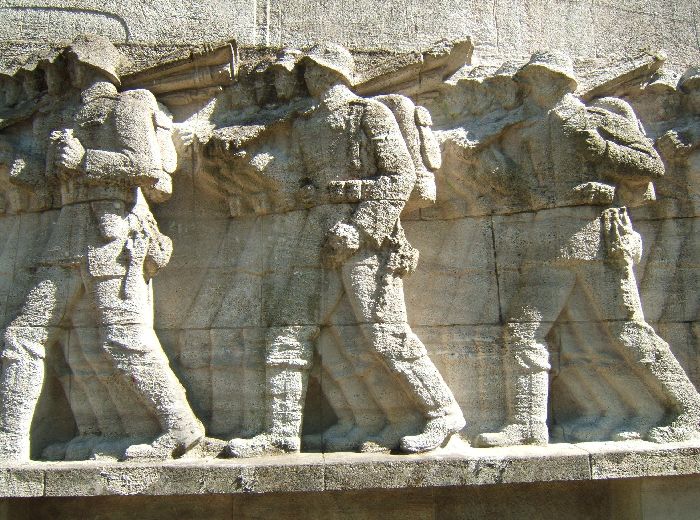
I didn’t expect to come face to face with a huge monument in the park. In lots of ways it was the same as any other big stone memorial to Our Brave Boys. But it wasn’t. It was to Their Brave Boys. The Germans. The enemy. And I didn’t know how to deal with it.

Monument to the 76th Infantry Regiment. A real slap in the face.
Monument to the 76th Infantry Regiment.

That was 2003. I couldn’t find any mention of it in guide books and I wasn’t sure which park I’d been in and eventually, even whether it had all been a dream. They couldn’t have left a memorial celebrating Nazi soldiers standing. They burned the whole city down. About 40,000 were burned alive here, by us, the Allies, the RAF and the US Army Air Force. It was called Operation Gomorrah. You don’t have to know a lot of your Bible to know this was about removing a city from the map. Forget the fairy tales of the Memphis Belle going round on its bomb run again to miss the school next door to the factory. 150mph winds burning at 800 C don’t miss things. They had no intention of missing things. I didn’t understand how this memorial had survived. If it missed the bombing there must have been no shortage of people with chisels and hammers in June 1945 to take care of it.

But there it still is, at Dammtor. You can read about it here. I’m not sure why it stuck in my mind. Because it wasn’t like a war memorial. Because it seemed triumphant. Because Our Brave Boys were wearing the boots and the wrong-shaped helmet, the Stalhelm. Because they were Germans. Because like everyone of my generation, the War was this huge thing that grownups didn’t talk about. That wouldn’t go away.

A man with one arm lived up the road from us when I was a boy. My parents disapproved of him because he wasn’t married to the woman he was living with. Her daughter bore the mark of their shame. Please don’t think I’m joking. It wasn’t all like the Darling Buds of May growing up in the English countryside.

“He didn’t lose his arm in The War, you know.”

It was always there. It was there in the names of the Polish kids at my school, it was there in the reason why there was an Italian motorcycle shop. It was there in the candles burning on a Friday night in the front window of the small family of pale, dark-haired people who kept themselves to themselves down a dark lane, the parents younger than I am now, the two girls, Miriam and Rebecca. I never heard them shout or scream, the way any other children did, but maybe there’d been enough screaming in their family already.

“Germany must live, even when we die.”

I left the monument and got back and walked up the stairs in my hotel, past the huge sailing ship hanging from the ceiling in the lobby and found a small window at the top of the building that didn’t look right. As I looked at it more closely I could see that the glass was thicker at the bottom of the window than at the top. I felt sick because I knew what had happened.

The fires from the bombs dropped by the RAF had burned so hot that the glass in the window had started to melt, 100 feet above the street. Now try to read that again after you’ve wiped your eyes.

It doesn’t matter how much you blow your nose. It will never be all right. It doesn’t matter who was right or who was wrong. The bell tolls for all of us.

Deutschland muss leben, und wenn wir sterben müssen.

One of the inscriptions on the memorial says “Germany must live, even though we die.” Or thereabouts. Just by the passage of time almost everyone who put on a uniform back then, any uniform, has died now. Almost all of them. But Germany lived. It became something greater than practically anyone then could possibly imagine. A country without a war. Even when we die.


Share Button

Training will be given

I’ve been going to job interviews lately, for the obvious reason that I need a job. Stupidly, I went to one interview in the market research world. Or maybe not so stupidly, because it reminded me exactly why I left it.

“We’re looking for a BRIC speaker.”

Really. So ok, you want someone who can speak Brazilian – wait, isn’t that Portuguese? – and Russian. And Indian and Chinese. But Indian, I mean. Urdu? Or Punjabi? Or all of these? Do you know? Or is this just my attitude problem thing again?

So the job spec then. Someone who can go and do groups. Oh and visually interpret them. Let me see. You mean go and do group discussions but through a translator, unless you’re doing them in Portuguese, Russian, Urdu and Mandarin simultaneously, who can also judge the body language of all of those different cultures at the same time.

This is why most groups are crap, isn’t it? Because you’re asking them to be something they can’t be, but you won’t say that, so you’ll pretend that’s exactly what they are. Except the only difference will be you’re going to get me to fly half-way round the world to sit in someone’s living room while their dog is locked in the kitchen so we can talk about different colours of packaging for biscuits. Ethically, obviously, but not including the ethics of flying around the planet to help sell sugary rubbish to the developing world.

Oh, and do the PR. Because that’s really easy, isn’t it? Or do you mean schmoozing the client in four languages at the same time, like Roy Castle playing a drum, banjo, cymbals and a whistle on Record Breakers? Is that what you really want?

And collaborate through the organisation rather than ‘lording it’ to use their phrase, in a small company. I badly let myself down there. I didn’t tell them to fuck off and walk out.

But they will book the tickets and a hotel.

Business culture – what’s yours?

They actually said that. If I’d been on the Two Ronnies circa 1977 I could have said thank-you, a large scotch and he could have adjusted his designer glasses while the audience screamed with laughter, but I’m not. I waited for the next question.

Semiotics. What does that mean to you?

Because I was trying to be a grown-up I didn’t smack my knee and point at him and say Haaaaa!!!! Good one!!

I should have. Like, what’s your sign, baby?

And shepherd the client. And do a few groups, ‘right up to a whole cultural immersion.’ So I can expect a sauna with Abba playing in the background. And Desiree Cousteau dropping her towel, presumably. Come on, there have to be some benefits for putting up with this stuff.

Going back, I walked down the street I used to live in a long time ago.

Still, there was a very nice coffee shop next door, just how I’d wanted mine to be when I opened that in a small Suffolk village. And sadly at 2:30 on a weekday it was just as empty.

Me nursing a coffee and a pecan tart, both excellent. Two builders from next door who wanted a warm and to use the loo. The owner was paying £750 a month to share a place in Kings Cross, just far enough to make it too far to walk and a really big hill if you decided to cycle.

The past is another country. It’s not just that they do things differently but you can’t go back because it’s not actually there now. I needed to remember what a tedious pile of self-deluded pretentious bullshit classic UK consumer qualitative research can be. In that, it wasn’t a wasted day at all. I thought I could do with the money, but I was wrong. I have not got time to listen to this kind of nonsense any more.

Share Button

Trotsky and me

Not really inconspicous.
Not really inconspicuous.

The only thing I learned about Trotsky  was a mistake. I hardly learned anything in three years of Sociology at university, other than the fact that you can’t run a car and a Triumph 650 on a student grant and that if you move in with your girlfriend next door to an occasional girlfriend your life will be a lot louder and considerably less fun than the Austin Powers script you had imagined. I don’t know if Trotsky had that kind of stuff to deal with but he had his own problems.

Like living in Mexico. I went there once. The story of that Sunday and the unfortunate misunderstanding in Tijuana is familiar to a select few very close friends and not usually told to people I’ve only just met, in case they wash their hands after shaking mine and their womenfolk’s faces turn to stone as you close for the parting peck on the cheek. More than usual, anyway.

In some ways I wished I’d paid more attention now. After leading a failed struggle (it says in Wikipedia, which has certainly been more useful than nine terms at Bath) the against kindly Uncle Joe Stalin, whose propaganda machine was still creaking on even when I was an undergraduate, Leon Trotsky did some groovy stuff. He got himself deported from the USSR in 1929, for a start. He lead a thing called the Fourth International in Mexico, opposing Stalin and bureaucracy. He thought the Red Army should fight Hitler when Stalin didn’t think anything of the kind and opposed Stalin and Hitler’s Non-Aggression pact, all of which British Soviet fans had airbrushed out of history when I was at school.

Predictably enough, all this didn’t go down too well with Stalin, who ordered Trotsky’s assassination in 1940. With an ice-pick. This was the only bit I knew then. Because it was so ludicrous. I’ve read James Bond. I understand that sometimes when you want to murder someone the ideal tool for the job isn’t available. But I’d have thought that the chances of finding an ice pick in Mexico were fairly slim, especially compared with the rather high chance of someone saying “where on earth are you going with that ice pick, Ramon?”

Leon Trotsky. Bad hair day.
And of course, it wasn’t like that. Trotsky really did get an ice-pick stuck in his head, but it was the kind you get in swanky hotels to break up the ice in the bucket behind the bar, not something you find near St Bernard dogs and chalet girls.

Last week I talked with someone who’d been shocked about someone else’s behaviour a quarter of a century ago and still regarded the other woman with awe if not admiration. Except I was able to tell her that actually, while all that may have happened it certainly didn’t to that person because I knew for a fact she was in another country at the time. She’d misunderstood something someone had said. A quarter of a century on she still believed it. I was sort of pleased to find it wasn’t just me.


Share Button

A book of verse and thou

It was raining pretty much all day from the time we got to the little town to the time we got back to my house, through three cups of tea and cheese buying and wandering around charity shops and marvelling that the Edinburgh Woolen Mill, a place which isn’t in Edinburgh and mostly seems to sell 100% acrylic jumpers is still open.

My friend decided against going in. As she said, “I’ve got another thirty years before I do that.” I didn’t tell her I’d been in earlier to see if there was anything to waste money on. Best not, given the difference in our ages.

I bought some Pecos from Spain and some Ossau-Iraty, then we wandered to another little shop where second-hand, or once-read books were 50p each. I bought a couple, Wildlife in America, the 1959 Beatnik proto-environmentalist set text, and The Day of The Jack Russel, because I could do with something silly and funny with a knowingly ironic title, because a) it’s pouring outside and b) that’s what I’m like. As we were leaving, after my friend found she couldn’t buy the chairs she wanted without the table she didn’t and after she’d bought an oil lamp which then needed us to tour the hardware shops to find lamp oil (found it) and a lamp chimney we had to go to a chandlery in Southwold for, ten miles away, where they ordered it, the old man behind the counter said the magic words:

“If you like books, there’s more upstairs, round the corner.”

The Bitter Road To Freedom

And there were. Thousands of them. Piled in old bookcases, stacked in cardboard boxes, most of them paperbacks and none over £1. Steinbeck’s Travels With Charley joined Collins Easy Learning German Dictionary joined Liberation: The Bitter Road to Freedom, Europe 1944-45 . Those five cost £3.50. Half what I paid for MacDonogh’s After The Reich on Amazon yesterday, and a million times more fun buying them, truffling around a forgotten room in a backwater town with a good friend in the rain.

I’d been in a bad mood that morning, wondering if any of these job interviews would come to anything, wondering if I should bother going to one in London when I’d either have to commute five hours a day or rent some crappy flat in one of the most expensive (but still crappy) parts of London, neither of which options sounded great. I got her to stop at a farm shop so I could get some bread and when I came back to the car gave her the little primrose I’d seen in a plastic pot, to say I was sorry for being such a pain earlier. She said “that’s alright,” and put the pot in the cupholder on the dashboard. “It fits very well, doesn’t it?”

Both of us have wondered where our lives are going over the past year. Today I realised how truly lucky we are. Nobody knows what’s going to happen tomorrow. Nobody at all, no matter what they’re paid or what they know or however much they’ve trained, however much they need to know exactly what’s going to happen. For all they know, some people are going to wake up dead. And today, for all that we didn’t save the world or cure cancer or do anything anyone else might think of as useful, we were alive and free to walk around a bookshop with the rain pouring down outside.

So many people aren’t. So many people never will be. The title of this self-indulgence comes from an old Arab poem by Omar Kyyaham, a man who didn’t love an electric shaver so much he bought the company. It probably was, anyway. I don’t speak any brand of Arabic so I have to rely on Edward Fitzgerald’s translation, although lots of his stuff sounds suspicioulsy like Fleetwood Mac:

Yon rising Moon that looks for us again-
How oft hereafter will she wax and wane;
How oft hereafter rising look for us
Through this same Garden – and for one in vain.

We drove back to my house and totally failed to get the desk I’d bought through the tiny door of my cottage. She said it was a pity.

“But you know, it would all be much nicer if you tidied up a bit. Threw some stuff away. Sorry. Maybe it’s not for me to say. If you want, I’ll help you on Sunday. I can’t do it on Saturday. I’ve got the Shoot Dinner to do. But I can do it Sunday morning.”

It’s how we live, here. Now. Sometimes it seems almost blessed.

Share Button

Drinking saved my life

Too much to drink usually isn’t a good thing for anybody. But once, and I mean once, it saved my life and the life of the person I was with.

We’d gone on holiday to Tenerife. We hadn’t known each other long and things were a bit fractious at times. So we went to lunch. It was a long lunch because to be honest, in the part of Tenerife we were in, there wasn’t much else to do.

But we found an OK restaurant, right next to the sea with a table that had a great view of the water and the harbour mouth and people swimming and the food was good and the wine was cheap and things started to get ok, even though the sky was clouding over a bit outside.

Then odd stuff started happening. I’ve been in earthquakes a couple of times in my life and I don’t like them. This was different. A Coastguard launch came out of the harbour with a megaphone blaring and a guy on each side of the boat with a long boathook. They took the boat right up to the few people swimming. I don’t speak Portuguese or Spanish or whatever it is they speak on Tenerife but I didn’t need to. “Get out of the water now or I’ll get you out of it” didn’t need a lot of translation.

That was when we saw that where the water had just been green it was now grey, except where, just near where the Coastguard boat was, a yellow streak about as wide as a road had appeared, right up to the water’s edge. About the same time the staff started looking nervous. It started to rain hard too.

The restaurant was closing but they said we could stay if we liked, so we did and we bought another bottle of wine, which was about the third probably. I’m not recommending this, but as I said, it did save our lives. We thought it was an odd time for the staff to start moving furniture upstairs, but it was their restaurant and what they did was up to them. We were starting to get on better.

Eventually the rain stopped, and so did the furniture moving. It had got all a bit Latin, a lot of banging around up there but again, not our problem.

The Coastguard boat had gone after scouring the rest of the harbour looking for people swimming, but there weren’t any more of them as we left the restaurant. Before we left we said something about how they could get on with moving furniture again, but the person we talked to didn’t seem to know what we meant. Which was when we saw the road. Someone had been throwing rocks around. There were walls down and bricks on the road. And police tape strung across parts of the pavement saying Do Not Cross and big chunks of rock in the road as well as some earthslides spreading down the the hill which one of these days is going to come right off, fall into the sea and tsunami New York, just like in the films.

Nobody was moving furniture upstairs in the restaurant, for the reason that there wasn’t an upstairs. What we’d heard was rocks being shaken off the hill and hitting the roof. None of them came through, but some of the debris we walked past on the way back to our hotel had smashed down parts of buildings. It was like a war zone, literally, as we picked our way through the rubble.

If we’d been walking along this street, the quickest way back to our hotel just half an hour earlier we’d both have stood a very good chance of being dead by now. As it was, we’d sat drinking wine and getting to know each other a little more, while the earth had split under the water of the harbour and tons of rock and earth had smashed their way down the hill.

Drinking kills people. It ruins others’ lives. I’ve seen it change people into something I didn’t even recognise. But just that once it definitely saved my life.

Share Button

A point between nowhere

Back in you don’t really need the date, I bought my first flat in a place called Finsbury Park Road. It was one of those bits of London that was supposed to be up and coming. It had been ever since John Betjeman’s Cockney Amorist belaboured himself about a lost love in the Park.

I will not go to Finsbury Park
The putting course to see
Nor cross the crowded High Road
To Williamsons’ to tea,
For these and all the other things

Were part of you and me.


In Finsbury Park’s case the up and coming-ness  meant that all the brilliant little shops like the place that sold hundreds of different kinds of tea, the two Chinese tool shops, the two butchers, the vegetable shops and West Indian restaurant, the kebab shop, the Arsenal Tavern which definitely wasn’t brilliant, the French cafe you went to on pay-day, the greasy spoon opposite where the French cafe owner not only ate but where his accent became a lot more Birmingham than Toulouse, the picture framing shop that had to be sold, the place that sold massively expensive fireplaces rumoured to have come out of the Iranian Embassy, all of those places except the Arsenal Tavern went.

The butchers used to drive in from miles out in Essex. So did the veg shop guys who learned to speak island Greek, because that’s what their customers spoke. The picture framing shop had to be sold because of a Friday night. The owner got a bit gobby in the pub and said something he shouldn’t have to someone who said ‘say that again, that’s libel, that is.’ The framer did and it was and had to find £30,000 out of nowhere, or out of his shop. As he was.

C'etais une autre pays.
C’est un autre pays.

The French restaurant, A Point Between Nowhere, closed I suspect when the owner died. He looked like a thinner version of Rene in ‘Allo ‘Allo, but totally without the charm. He combined what he clearly thought was Parisien hauteur with a patronising manner bordering on aggression, which is probably where I learned it from. If you had a ten year-old Jaguar and one of those orange wives with capped teeth and a crennalated cleavage you couldn’t get him off your table all night. His prices were ludicrous but the food was pretty much the best around for miles, or certainly around there, then.

What we also had which went away for a bit then came back, was prostitution. My boss at work had lived in the same street ten years before and told me how the only way not to get hassled walking down the street to buy a pint of milk was to carry an old fashioned shopping bag on your arm; apparently it was code for ‘I’m not working.’

In the absence of a shopping bag the message was seen to be ‘stop me and buy one,’ long before anyone had even invented semiotic deconstruction. That was the way it was. And it was a pain.

I got back to my flat one night very late and probably I shouldn’t have done. I dropped my car keys and realised I hadn’t turned the headlights off and got in the car through the passenger door and crawled over the seat to switch them off, got out, dropped the car keys again. As I walked up to my front door a point police helmet popped up behind my dustbins. I asked the policeman what he was doing in my garden.

‘We’re looking for prostitutes.’

I told him I didn’t think he’d find any behind my dustbins.

‘Ah no. We’re hiding from them.’

In the circumstances I thought it best to leave him to it and bade him a good evening, which behind my dustbins I thought was unlikely.

Someone left the front door of the house open one day, so several of us were treated to some stranger on the stairs asking for Tanya or Suzy or whatever other bullshit name he’d been given the last time he’d visited the house, before it got converted into flats.

When I turned the sound down on the TV one night I heard a voice from the front garden asking ‘do you want to do a tenner for some gear?’ which I presumed wasn’t the policeman back behind the bins again.

I looked through the shutters and found three women sitting on my garden wall. One of them was heating something in a spoon that she held a cheap lighter under. I called 999 and told them about the drug taking on my garden wall.

The police asked me how I knew it was drugs. I said that when people burned things in spoons and said things like ‘do you want to do a tenner for some gear’ I generally thought all the references so far were for heroin. The policeman said I sounded as if I knew a lot about drugs and asked for my address. I told him if they were going to send the plainclothes car not to bother sending the Vauxhall with two radio aerials because everyone knew it was a police car and we left it there.

You Really Wouldn’t

They didn’t want to do anything about the real crime. The same way they didn’t want to do anything about prostitution except hassle the girls who without exception looked as if they’d have to give you money and quite a lot of it, rather than the other way around. Obviously, people’s tastes differ, but they were all fat. The poor girl who waited at the bus stop and never got on the bus for four hours in February wore a mini skirt and no tights. If you weren’t into purple thighs you were out of luck.

In Sweden the government has done a sensible thing. Instead of hassling the girls they hassle the buyers, by making the purchase rather than the invitation to the purchase the illegal thing. Back in Funsbury Park we did much the same thing but without the legal backing.

Because we were fed-up with not being able to get parked on a Friday night, because we were fed-up with smackheads shooting up on our garden walls, because we were fed-up with women getting into the passenger seat when we’d just stopped in the road to reverse park into a space, because we were fed-up with having to get people out of our gardens when we came home, we came up with A Plan.

Operation Brightside

We didn’t have mobile phones. Or the internet. But we did have flash on our cameras, whether or not we had film in them, so we set that off when we walked down the street, pointing our cameras at cars that had stopped in the road for no traffic-related reason. It really worked. A couple of free flashes of a kind the Friday night motorists hadn’t been expecting and all the cars left in a hurry. We got a bit of what used to be called verbal from some of the girls about how they hadn’t done anything wrong. But neither had we, so we couldn’t see what the problem was.

Actually, we could. I don’t think any of us had any moral issue with the girls selling what they could if anyone was desperate enough to buy it. But we were totally fed-up with that happening in our street, in our own gardens. I didn’t want to have to get junkies off my garden wall. I didn’t want to have to deal with syringes in my front garden. And women who lived there were fed-up of it being assumed they were prostitutes simply because they didn’t have a Y chromosome or up for it if they didn’t own a shopping basket.

So we stopped it. A few years later the Director of Public Prosecutions was arrested for kerb crawling. Unsurprisingly, he never went to court, because in England once you’ve got to a certain position in society you almost never, ever, ever go to court whatever it is you’ve done.  His wife said she would stand by him. She left him and killed herself a few months later. She came from Gothenburg. I’ve been there. Good cheese and a 1950s feel to the place, but bone-snappingly cold in February. Today if we’d got our cameras out and inconvenienced the DPP we’d probably have been branded ‘terrorists’ and been arrested ourselves.

But the past really is another country. It depends whose version of the rest of the quote you want, Christopher Marlowe’s (himself a man not unfamiliar with dodgy pubs in the wrong bit of London) or JR Hartley’s. The wench may well be dead, sadly. But they definitely do things differently there.

Share Button

I’m in the Landie, yah?

I don’t know why agricultural stuff like green wellies and shooting and Land-Rovers got so popular in the 1980s with people who wanted to be thought of if not as ‘posh’ then certainly as Sloanes.

Like, RARELY nice.
Like, RARELY nice.

Both things were invented. Or rather the labels were invented. Posh was supposed to stand for (maybe) Port Out, Starboard Home, describing which side of the ship one’s cabin had been booked for the passage to India, before you stood with everyone else taking their belts and shoes off, not at a swingers party or a mosque but in the Departures security queue at Heathrow. Except some people say it didn’t mean that at all.

Sloanes were obviously a more recent invention. Peter York made them up, or at least the label, when he helped to write the Official Sloane Ranger Handbook back in the dawn of Thatcherism, when dinosaurs roamed the earth. Or if not the earth, then at least the Cromwell Road and Sloane Square and when in my own memory, someone on a very ordinary income could still just about afford a house, no, a proper house, not a flat, in Fulham, if you didn’t mind being down the wrong end. Assuming there even is one anymore. Which was the funny thing. There weren’t real dinosaurs, obviously. Just people whose behaviour hadn’t changed much since 1910. The boys got jobs in the Army or a bank or publishing, quite often straight from school and did well, because people did in those jobs when they didn’t really need to work. The girls – well, that was another story. Everyone had a Sloane girl story.

Even at the BBC, when they started getting jobs instead of, or usually before marrying a merchant banker, the keen, enthusiastic Fionas and Vickys (never Kellys, or Tanya, although there was a Tansy I remember, notwithstanding that James Bond’s wife was called Tracy) were dubbed VodaSloanes back in the day. They were the only people who somehow, nobody quite knew how, had mobile phones back when only Bodie and Doyle could call the office without going to a phone box.

And like me, they liked all that stuff. Some of them even liked me, a bit. I’m looking for a car and like them, like then, like now, whatever the specification, whatever I actually need it to do, I always think ‘hmm, what about a LandRover?’

Not a Disco. Not a RangeRover. A proper one. A real Landie. A Defender. Even the Financial Times is talking about them. Although they’ve been making them since 1948 with not many changes, although Americans don’t like them, although it’s unclear how that’s a bad thing in itself, LandRover, or at least the Indian Tata corporation, has decided to stop making them.

The FT claims the lack of a crumple zone and the thin, bendy aluminium bodywork makes them unsafe. I know for a fact it isn’t, because a ladder chassis saved my life.

Like the rest of a LandRover, a ladder chassis is an old-fashioned thing. Think of two big bits of metal, like a railway line, running the length of the car. The rungs are the axles and the bumpers. Everything else is bolted onto that. It doesn’t crumple. That’s the whole point. In a front or rear collision, all the weight is transferred along the ladder. If you’re on the other end of it, that’s a problem. I suspect that’s the ‘safety issue.’

I hit a Ford Mondeo just in front of the driver’s door on a streaming wet lane and opened a hole down the length of the car. I had a small scratch on my bumper. That was a bit embarrassing.

A year later I hit a lorry coming the other way, just managing not to hit it head on and impacting just behind the cab. A policeman saw it happen and ran over, opening my door white-faced expecting to find blood and body parts. I was fine. Ladder chassis, officer.

The fact that the atrocious handling of the thing caused both accidents isn’t the point. And now they aren’t going to make them anymore, the only question that matters is the one I’m asking myself a lot these days.

If not now, when?

Share Button
Follow on Feedly